


People can recognize a partner by smell. Newborns respond to smells from the breast. In lab tests, body odors can also change how someone reads a face or responds to a threat.1, 2, 3
These smells come from chemicals made by the body and by the microbes living on our skin. Scientists have identified many of the chemicals, worked out how some are made and tested how people react to them.4, 5, 6, 7
Some experiments test one chemical, such as androstadienone or hexadecanal. Others test whole samples of sweat or tears. With a mixture, the response belongs to the sample tested until its ingredients are tested separately.8, 9, 10, 11
A pheromone is a chemical released by one member of a species that causes a particular response in another. Establishing that role means checking the chemical, the response and the amount normally encountered. Human experiments need those same checks.12, 13
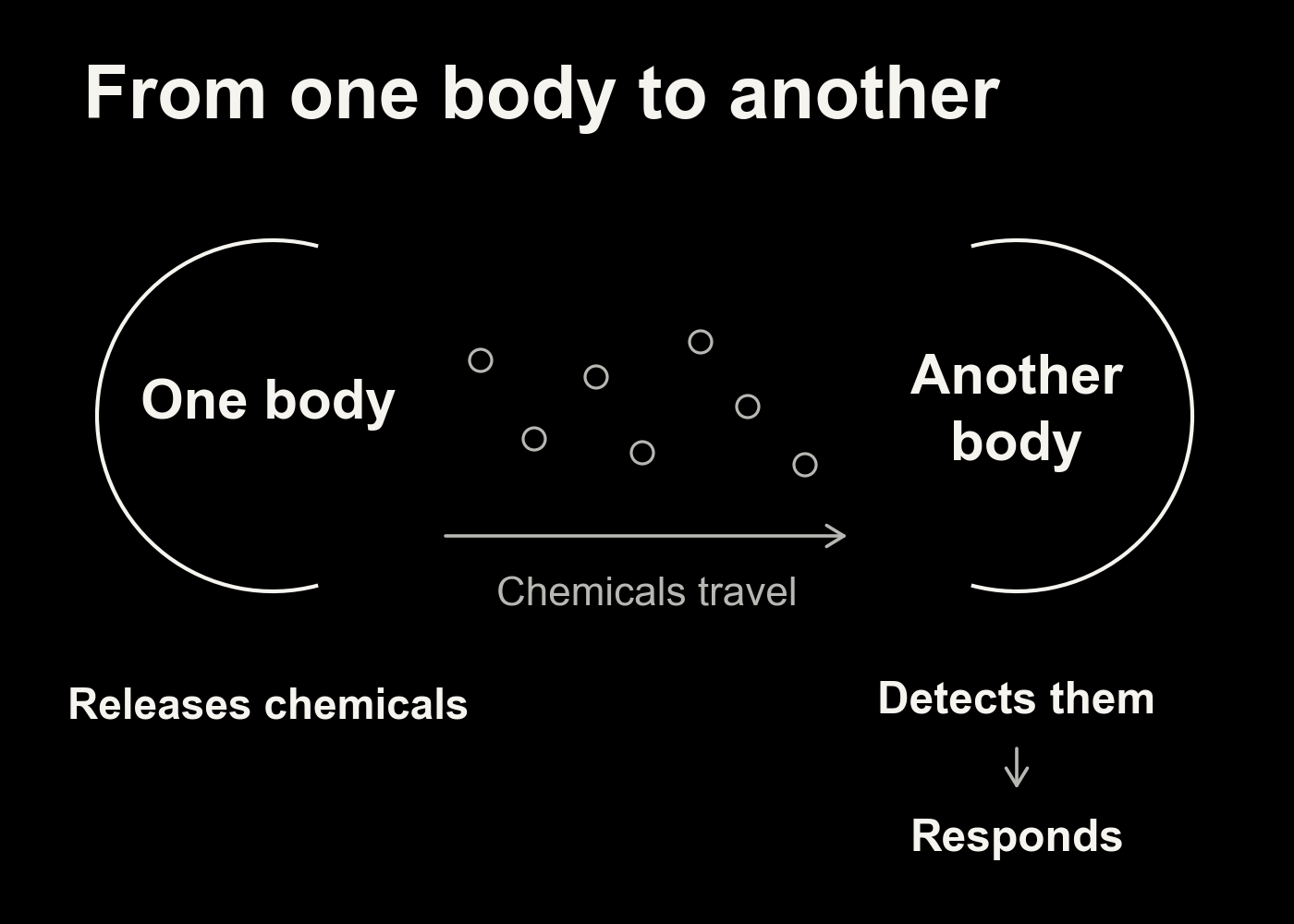
Finding a chemical is the first step. Researchers also need to show how it reaches another body, how that body detects it and what happens afterward.13, 1
Contents
What a pheromone is.
How researchers identify a pheromone.
Pheromones in other animals.
How the body produces odor.
How the nose detects odors.
Body odor and sexual attraction.
Body odor, fertility and hormones.
Body odor and relationships.
Communication beyond attraction.
Perfumes, products and patents.
What research has found so far.
Glossary.
Find a topic
Steroid names: 4.2 and Glossary. Food and body odor: 4.4.
Androstadienone: 6.1. Androstenone and androstenols: 6.2.
Androsterone and ADL: 6.3. Estratetraenol: 6.4.
Sexual orientation: 6.5 and 8.1. Copulins: 6.6. Sexual enjoyment and arousal: 6.7. Seeing someone with a partner: 6.8.
Fertility: 7.1–7.2. Breastfeeding scents and adult responses: 7.3. Periods starting together: 7.4. Sperm responses: 7.5.
Immune genes: 8.1. Birth control: 8.2.
Dominance and rivalry: 8.3. Recognizing people: 8.4. Age: 8.5.
Newborn feeding: 9.1. Fear and happiness: 9.2–9.3. Illness: 9.4.
Tears and aggression: 9.5–9.6 and 6.1. Products and patents: 10.1–10.2. Personal reports: 10.3.
1. What a pheromone is
A hormone carries a message inside the body that makes it. A pheromone carries a message from one member of a species to another. Peter Karlson and Martin Lüscher introduced the word in 1959. They used it for a substance released outside the body that changes another animal’s behavior or causes a slower change in its body.12
Pheromones have many uses beyond sex. They can travel through air, water or food, or pass between animals when they touch. One chemical may do the job, or several may need to work together. How much is present, and how much of each ingredient is in a mixture, can change the result.12, 13
Smell can also give away information. A predator can use an animal’s smell to find it, even though this does the hunted animal no good. Scientists call this a cue. They use signal for a feature that evolved to help animals communicate. A signature mixture is a combination of chemicals that helps identify a particular animal, often because others have learned its smell.13
The same body fluid can carry several kinds of information. Some of its chemicals may be common to a species. Others may change with the animal’s condition. The overall smell may also be familiar enough to identify that animal. Recognizing someone by smell does not require each person to have a pheromone unique to them.13, 1
An animal’s reaction to a pheromone can change with its age, physical condition, experience and the other smells around it.13, 14, 15
2. How researchers identify a pheromone
Researchers begin with a response they can measure, such as a newborn animal searching for milk. They test natural samples, separate the ones that cause the response and keep testing their smaller parts. This is a bioassay, a test that uses a living response to find an active substance.13, 16, 17
Once they identify a suspected chemical, they check it against a known sample or a copy made in the lab. Removing it from the natural mixture and adding it back helps establish its role.13, 18
Schaal and colleagues did this with rabbit milk in 2003. Removing the chemicals that escape from milk into the air weakened newborn rabbits’ head and mouth movements toward a nipple. Adding 2-methylbut-2-enal, or 2MB2, brought those movements back.16
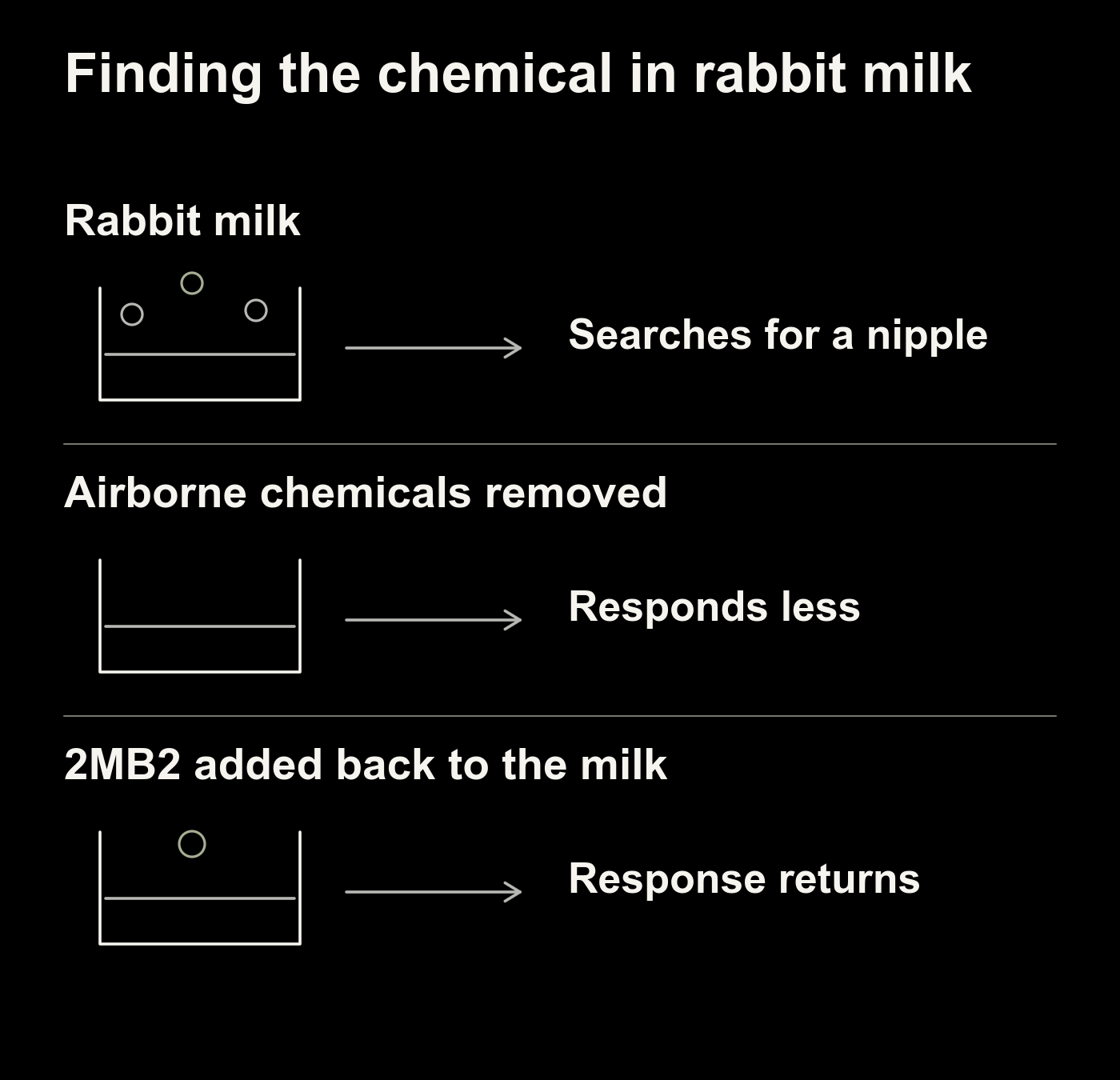
The steps in Schaal and colleagues’ rabbit-milk experiment. The symbols show what was removed and added, without representing exact amounts or the size of the response.16
The rabbits responded before their first feed, although exposure before birth was possible. More 2MB2 did not always produce a stronger response. The amount matters, especially when comparing a lab test with what an animal normally encounters.16, 13
A receptor is a protein that responds to certain chemicals. Giving silkmoths another moth species’ receptor made them begin mating behavior in response to that species’ chemical. This worked when the receptor was placed in cells normally detecting the silkmoth’s sex pheromone. Placing it in other smell cells did not produce the same behavior. The cells receiving the chemical, and the signals they send onward, help determine the response.19
In human experiments, a control is a comparison sample without the ingredient being tested. Unused pads reveal odors from the collection material. Changing sample order helps account for practice or fatigue. Keeping people unaware of which sample they receive reduces the influence of expectations. Tests with new people and in other labs check whether a finding holds up.7, 20, 21
Statistical significance means a result passes a chosen test of how surprising the data would be if there were no effect, given the test’s assumptions. It says little on its own about how large or useful the effect is. A null finding means the test did not find enough evidence for the expected effect. Small studies can miss real changes.20
Researchers also need to measure exposure. The amount dissolved in a bottle differs from the amount reaching a nose. Evaporation, airflow, distance and the delivery device all affect that journey.13, 21
3. Pheromones in other animals
Argentine ants followed trails made from two chemicals found in their natural trails. Adding a little of a third suspected trail chemical made the ants respond more strongly. Both the mixture and where it was placed on the ground helped guide them.17
One smell can change how an animal reacts to another. Honeybees attacked a moving dummy more often when an alarm chemical called isoamyl acetate was present. Some flower smells, including linalool, reduced the attacks. The result depended on which flower chemical was used and how the alarm sample was prepared.14
Male mouse urine contains a protein called darcin. Female mice encounter it when they investigate and touch the urine. Tests with a copy made in the lab showed that darcin helps make the scent attractive to females. Contact with it also helped females learn to recognize the smell of a particular male’s urine from a distance.15
Pregnenolone and androstenedione attract female red-bellied newts ready to breed. Toyoda’s team identified both steroids in fluid released by pieces of a male scent gland. In water tests with eight females per test, the females spent more time near sponges containing 0.4 nanograms of either steroid. When the team applied both steroids together with sodefrin, a peptide released by males, the electrical response in smell tissue exceeded the separate responses added together. Pregnenolone has a direct role in this courtship system, where the chemicals travel through water.22 An earlier report from the same team found that blocking the females’ nostrils removed their preference for pregnenolone and androstenedione.23
4. How the body produces odor
Several kinds of glands contribute to body odor. Eccrine glands make much of the watery sweat that cools us. Apocrine glands, found in places such as the armpits, release sweat with a different mix of ingredients. Sebaceous glands make skin oil, also called sebum. Fluids from the mouth, breasts and genitals contain other chemicals. Each part of the body also has its own mix of microbes.1
An armpit sample tells us about only one part of a person’s smell. Breath, hair, clothing and other skin areas can carry different chemicals. Some easily enter the air. Others mostly stay on the skin or fabric. Chemicals that enter the air are called volatile.1, 24
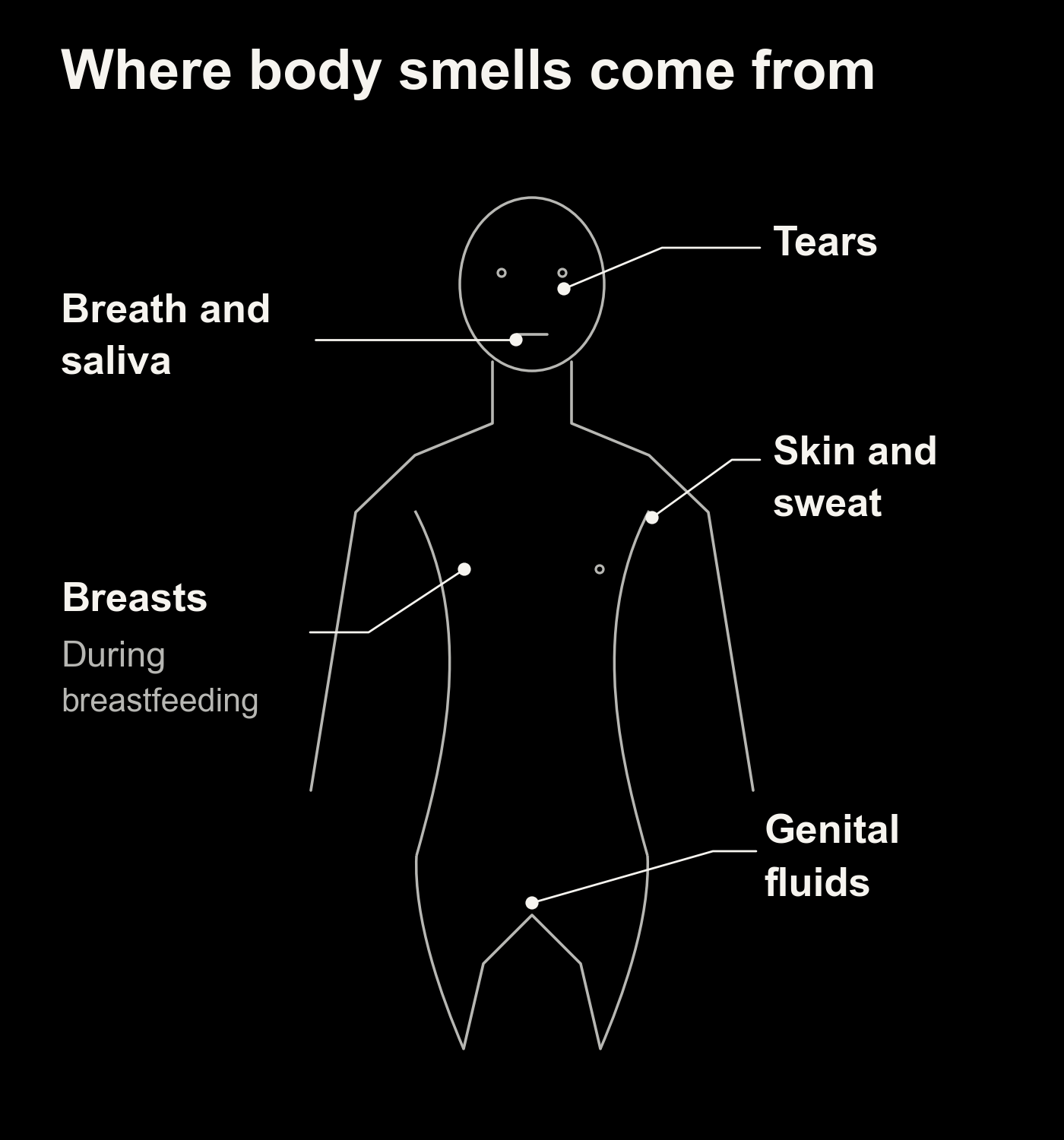
Each part of the body releases a different mixture. The breast label refers to research during breastfeeding. These are sources of body chemicals. A chemical found there still needs testing before it can be called a pheromone.1, 24, 2
A 2021 review collected reports of 2,746 chemicals from human breath and body samples. A separate skin review listed 822 chemicals across 29 studies. These lists overlap. They include substances made by the body, substances made by microbes and substances picked up from food, products or the environment. The reviews counted chemicals found in samples. They did not test each one for a response in another person.25, 26
In 2024, Diana Owsienko and colleagues compared underarm samples from 18 children aged 0–3 and 18 aged 14–18. The older group’s samples contained odor patterns matching androstenone and alpha-androstenol, two of the steroids studied in human scent. Neither was detected in the younger group’s samples. Several acids also remained detectable after greater dilution in the older samples. The researchers pooled samples from several children for each analysis, so these findings describe group differences.27
4.1. How skin bacteria produce odor
Some strong armpit smells start as chemicals that barely smell at all. The body releases these starting materials, called precursors. Certain skin bacteria take them in and turn them into strong-smelling chemicals.5, 6
One example is 3M3SH, a strong-smelling chemical that contains sulfur. In the material released onto the skin, it is attached to two amino acids, the small units used to build proteins. A skin bacterium called Staphylococcus hominis takes in this linked molecule. One enzyme, a protein that speeds up a chemical reaction, removes the amino acid glycine. A second enzyme frees the smell-producing part from the remaining amino acid, cysteine. Researchers have identified these enzymes as ShPepV and ShPatB.5, 6, 28
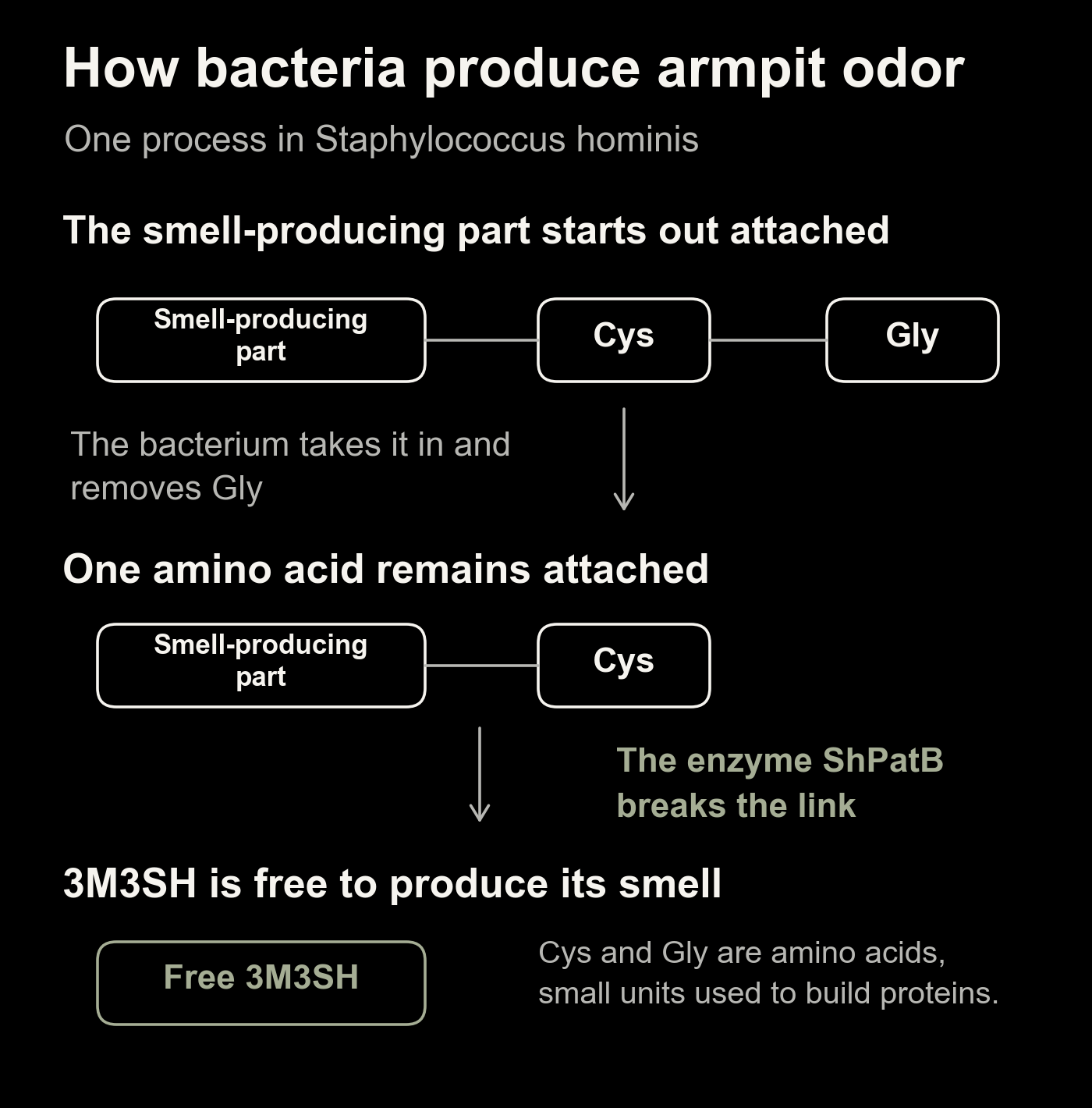
One way bacteria produce armpit odor. Cys and Gly mean cysteine and glycine, two amino acids. The shapes show which parts are attached. Other products of the reactions are left out.5, 6
Not all skin bacteria do this. In the enzyme study, another common skin bacterium, Staphylococcus epidermidis, could not process the starting material in the same way. The kinds of bacteria present matter, as well as their total number.6
The gene ABCC11 helps control which substances pass out of cells. Different versions of this gene affect how much of certain odor starting materials reaches the armpit. This changes what the bacteria have available to work with.29, 30
Experiments also explain an earlier step. The ABCC11 protein moved a larger, linked form of 3M3SH in a lab test. A human enzyme called GGT1 cut off one part, leaving the two-amino-acid form that bacteria can use. The researchers found GGT1 in human sweat glands too. This links human gland chemistry with the later bacterial reactions on the skin.31
Two other important armpit smells come from acids called HMHA and 3M2H. The body releases them attached to the amino acid glutamine. Certain bacteria have an enzyme that cuts this link and releases the acids. Different bacteria have different tools, so the starting chemicals and the species living on the skin both affect the final smell.32
Having different amounts of a chemical does not mean everyone reads it as a male or female scent. In a study published in 2025, 2,716 museum visitors smelled lab-made samples of HMHA and 3M3SH, called MSH in that paper. Women rated MSH as slightly more feminine than HMHA. Men made no clear distinction between them. Ratings varied widely, and smells people liked more were more often described as feminine. The study measured how people described the two smells.33
4.2. Steroids with similar names
Several chemicals studied as possible pheromones are steroids. Their atoms form a set of connected rings. Androstenone, androstenols and androstadienone belong to a group called 16-androstenes. They share a double bond, a particular link between two carbon atoms. Their other chemical features differ.34, 35
These names refer to different compounds:
Androsterone and androstenone are two different chemicals.
Androstadienone, or AND, differs from androstenedione, a starting material for other hormones.
3α-androstenol and 3β-androstenol have the same parts arranged differently.
Androstadienol, or ADL, can serve as a starting material for other 16-androstenes.36, 35
The α and β symbols are the Greek letters alpha and beta. They describe which way part of a molecule points. That small difference can change how a receptor or enzyme responds to it. Results for one form cannot simply be applied to the other.18, 13
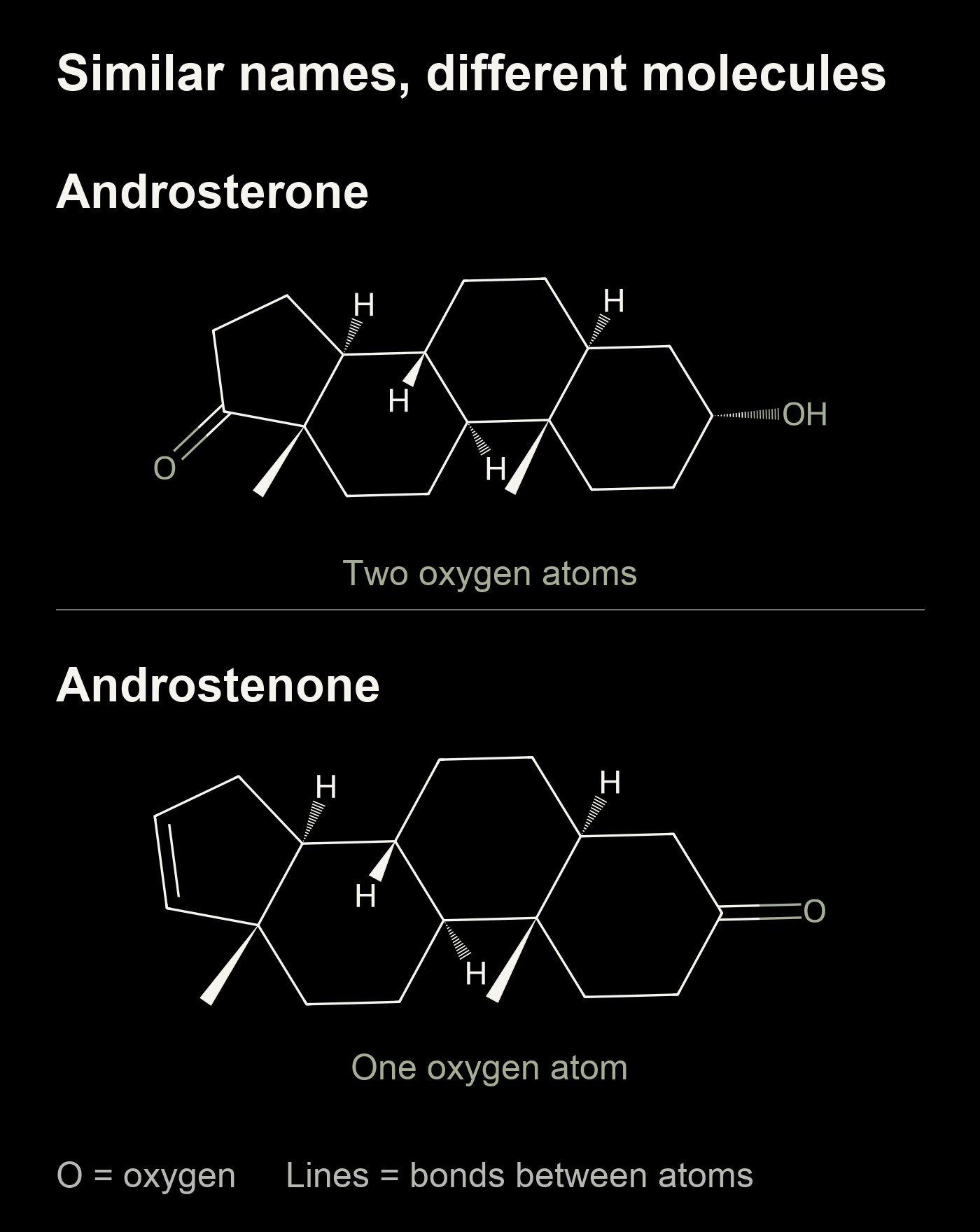
Each corner or unlabeled line end stands for a carbon atom. Most hydrogen atoms are left out. O stands for oxygen. These molecules have different bonds and oxygen-containing parts, so they can act differently in the body.36
4.3. How the body makes these steroids
Pregnenolone can become steroid odor chemicals. Researchers measured its conversion into ADL in material from human testicles. In lab-grown cells, the human enzyme CYP17A1 performed this reaction, with more ADL produced when the helper protein cytochrome b5 was added.37, 38
Further tests with human enzymes traced ADL to AND, then androstenone and 3α-androstenol. 5α-reductase type 2, also called SRD5A2, carries out the AND-to-androstenone step.35
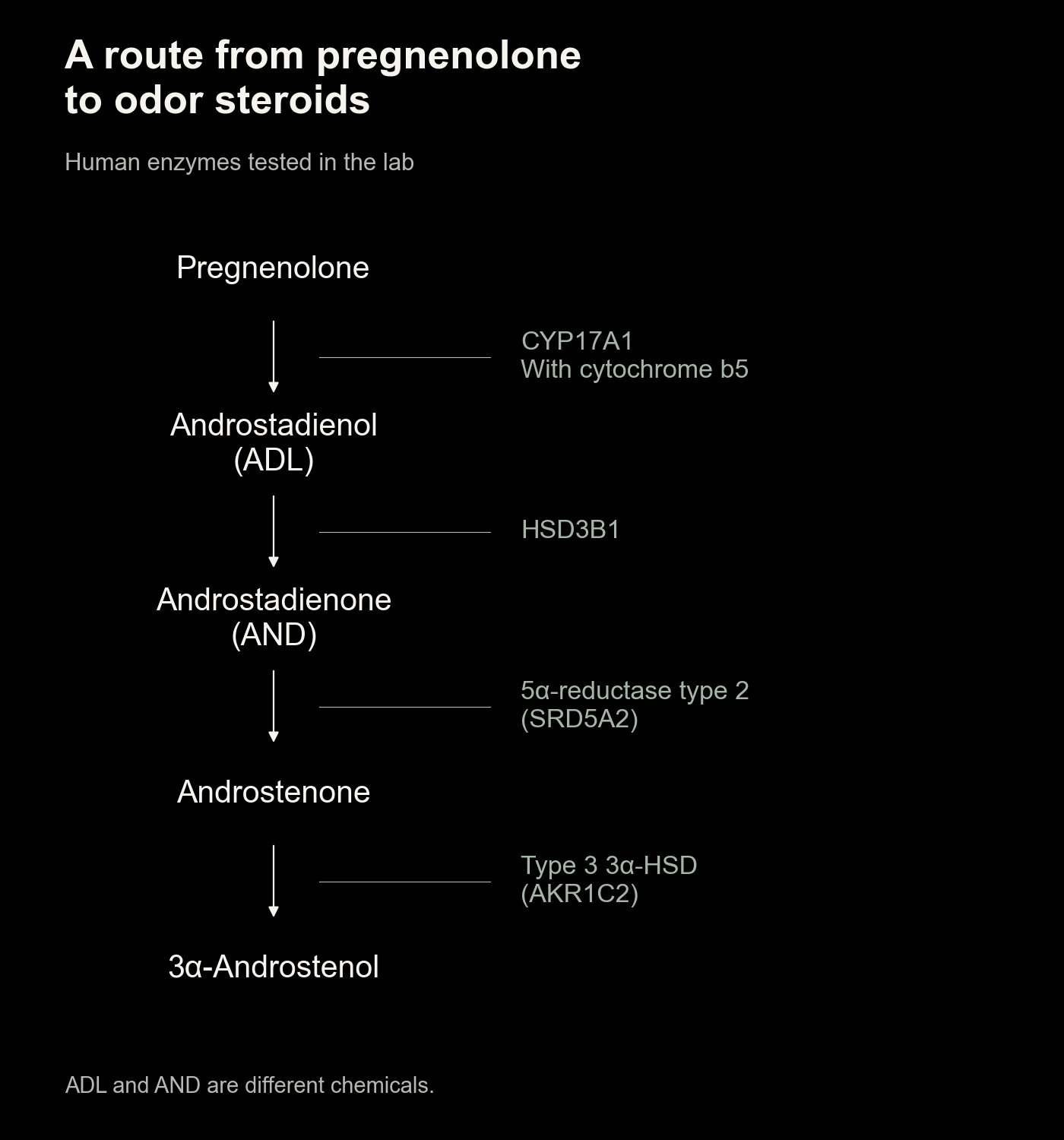
A production route tested with human enzymes in lab-grown cells. ADL means androstadienol, and AND means androstadienone. Cytochrome b5 helps the first reaction. Other chemical helpers are NAD+ for the second step and NADPH for the last two. The diagram does not measure how much a living person produces.38, 35
For more on the enzyme in this diagram, see my guide to 5α-reductase. It covers the factors that change its activity, with human, animal and cell findings identified separately.
The body also attaches sulfate groups to steroids. Labows and colleagues found androsterone sulfate and DHEA sulfate in fresh drops from seven men’s armpit glands. Heating these samples during analysis created additional odor chemicals. Those products came from the measuring process.39
Armpit bacteria can break down androsterone sulfate. Gower’s team found free androsterone and small amounts of AND or androstenone, depending on the bacterial strain. They measured the products without identifying every enzyme involved. In the body, SULT2A1 can add sulfate to DHEA. Cell tests showed that increasing DHEA eventually stopped producing a matching increase in the reaction rate.40, 41
Skin cells make and change hormones too. With the necessary enzymes, DHEA can become androstenedione, then testosterone, which can become DHT or estradiol. These hormones act within the skin. Tracing their contribution to scent requires measuring what reaches the surface and enters the air.42, 1
Hormone-derived material does reach the skin. In 1970, Brooksbank tracked labeled pregnenolone and progesterone in one man for 36 hours. He recovered labeled pregnenolone, DHEA, androstenedione and related steroids. Small armpit pads recovered about as much label as a much larger collection from the rest of the body. Most armpit label was in steroids with sulfate groups attached.43
Later studies measured testosterone, estradiol and progesterone in sweat. Muir’s team found all three on men’s and women’s faces after exercise. Among 13 men, levels were much higher in armpit sweat. Another 72 men provided armpit testosterone and estradiol measurements. The team could not collect enough women’s armpit sweat for that comparison.44
Elliott’s follow-up enrolled 73 men, with 49 completing all four visits. Men with higher armpit testosterone or estradiol readings tended to stay higher across visits. Estradiol readings were higher when a female researcher collected the samples. Only one researcher of each sex took part, so other differences between them could explain this result.45
Both studies used antibody tests that also react to related chemicals. The testosterone test, for example, responded strongly to DHT. The proposed transfer of hormones through skin contact was not measured, nor was attraction caused by it.44, 45
Sweat contains cortisol and cortisone too. Alvi’s team measured both in 50 volunteers, checking their identities against reference samples. Runyon’s team measured them and four breakdown products in four people during exercise. Both studies measured what left the body in sweat.46, 47
One study connected changing steroid levels with odor ratings. Shah’s team measured 16 steroids in shirts worn by ten men receiving hormone suppression for prostate cancer. After three months, androsterone and 5α-androstane-3,17-dione had fallen. Scent attractiveness, masculinity and strength ratings stayed similar. Of the 100 raters, 50 were women, all using hormonal contraception. The chemical measurements came from fabric extracts, not inhaled air.48
4.4. Food and body odor
What a person eats can change how their body odor smells to others. In a small experiment, 17 men followed a diet with red meat and a diet without it, each for two weeks. Thirty women rated their armpit samples. Ratings favored the samples from the meat-free period. The difference passed the researchers’ statistical test when they counted each woman’s ratings separately, but not when they counted each man’s average score separately. With only 17 men providing the smells, the result leaves considerable room for differences between people.49
Garlic produced another useful comparison. Fialová and colleagues tested armpit samples after men ate garlic and after a comparison meal. The first experiment found no clear change. A second used more garlic and found slightly higher attractiveness and pleasantness ratings. A third used garlic capsules and again found higher attractiveness ratings, but no clear change in pleasantness. The women smelled armpit samples in jars. They did not smell the men’s breath or meet them. These experiments show why the body area and the way a sample is collected matter.50
4.5. Collecting odor from skin and air
A pad pressed against skin collects a different sample from a material held above the skin to trap chemicals in the air. Collecting that surrounding air is called headspace sampling. These methods can produce different lists of chemicals from the same body area.51, 52, 53
Finding a chemical on a pad does not tell us how much reaches someone nearby. Nor does the chemical present in the largest amount necessarily contribute the most to the smell. It also matters how easily it enters the air and how sensitive the person smelling it is.13, 53
4.6. Other routes to body odor
Skin oil reacts with air to make new smells. Squalene reacts with ozone to form smaller chemicals, including geranylacetone and 6-MHO, without an enzyme. In a 2025 chamber study with three men, researchers collected breath separately to measure what left the skin. Clothing and oil left on clothes affected these emissions.54
Another part of skin oil, sapienic acid, can react with ozone to form decanal. The enzyme FADS2 makes sapienic acid from palmitic acid. Sapienic acid and palmitoleic acid have bonds in different positions, so their breakdown can produce different odor chemicals.55, 56
Hormones can change the material available for these reactions. In human oil-gland cells grown in the lab:57, 58
CRH, a hormone involved in stress, increased fat content and briefly increased activity of the gene for 3β-HSD, an enzyme used in steroid production.57
IGF-1, a hormone involved in growth, increased fat production, including squalene, and the protein SREBP-1, which helps control that production. Insulin also changed fat production, with different effects at the two concentrations tested.58
Thyroid hormones affect skin oil in people. A study of 50 patients, including 38 women, found less forehead oil in those with an underactive thyroid. In 20 measured again after thyroxine treatment, oil output rose but remained below normal. An overactive thyroid showed no clear increase. The study measured oil quantity, without testing its smell or effect on attraction.59
Skin bacteria also use sweat. Hara’s team traced lactate through pyruvate and a short-lived intermediate to diacetyl, a chemical involved in scalp, foot and armpit odor. Bacterial enzymes perform the earlier steps. The final step can happen through a reaction with oxygen.60
Some bacteria supply other species with the ingredients they need. In mouth-bacteria experiments, one species supplied ornithine, an amino acid. Another used it to increase methanethiol, a sulfur chemical in bad breath. Blocking ornithine transport removed the increase.61
A similar partnership produces putrescine, associated with vaginal odor. A 2025 study examined bacterial proteins in samples from 29 women, with and without bacterial vaginosis. Separate culture tests showed one species making ornithine from arginine and another turning it into putrescine. Growing them together increased production. Attraction was not tested.62
Urine carries odor chemicals both free and with other groups attached. Enzyme treatment of samples from eight women and six men released much more indole, guaiacol and vanillin. These attached forms provide material from which further reactions can release odor.63
An applied ingredient can change on skin too. Rohto reported that odorless sodium 4-hydroxyundecanoate released sweet-smelling γ-undecalactone in a seven-person skin test. Lab tests also found conversion with skin acids or the fat-splitting enzyme lipase. This was a perfume ingredient applied to skin, rather than a study of the body’s own lactone production.64
Producing an odor therefore depends on the starting chemicals, the cells and microbes processing them, and exposure to air. An enzyme’s name alone cannot tell us how much scent someone will release.38, 31, 60, 62, 54, 42
5. How the nose detects odors
Smell begins when chemicals reach a small area high inside the nose called the olfactory epithelium. Nerve cells there have receptors that react to chemicals in the thin layer of mucus. This starts electrical signals in the cells.65
Those signals travel to the olfactory bulb, a part of the brain that first sorts smell information. Other brain areas help us recognize the smell and connect it with memories, feelings and what is happening around us. One chemical can activate several kinds of receptor, and one receptor can react to several chemicals. The combination helps the brain tell smells apart.65, 1
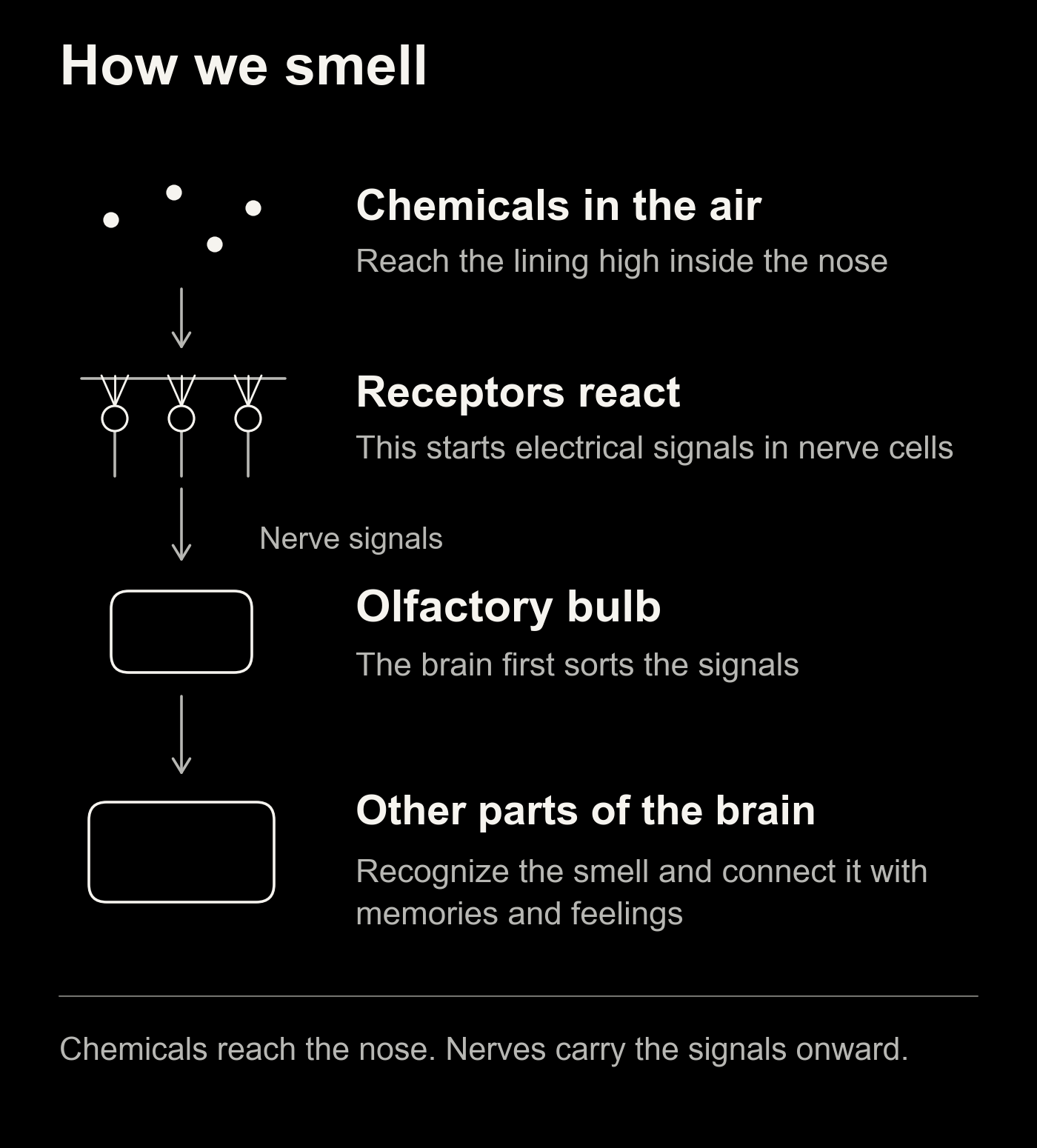
Chemicals reach the nose. Nerves carry the signals to the brain. This diagram shows how smell works in general. It does not identify a separate system for human pheromones.65, 1
A smell can cause a response through nerve signals without showing that the chemical entered the blood or reached the brain itself. Another nerve, the trigeminal nerve, detects sensations such as stinging, irritation and cooling in the nose. This matters when experiments use strong amounts of a chemical that might also irritate the nose.65, 21, 24, 66
5.1. Why people smell the same substance differently
People can smell the same chemical differently because their receptors respond differently. Keller and colleagues studied one receptor called OR7D4. Different versions of its gene changed how the receptor reacted to androstenone and AND in the lab. Those versions were also linked to differences in people’s smell tests. Some people needed more of the chemical to notice it and found its smell less unpleasant.7
The weakest amount someone can reliably smell is their detection threshold for that chemical. A person can smell most things normally yet struggle with one particular chemical. This is called specific anosmia. The result depends on the amount used and how the test is done.7, 66
In a 2025 study, 68 people initially could not smell androstenone well enough to pass the study’s test. After about two months of repeatedly smelling it, 49 passed and 19 still did not. The researchers found no clear link between the OR7D4 gene version tested and who learned to smell it.66
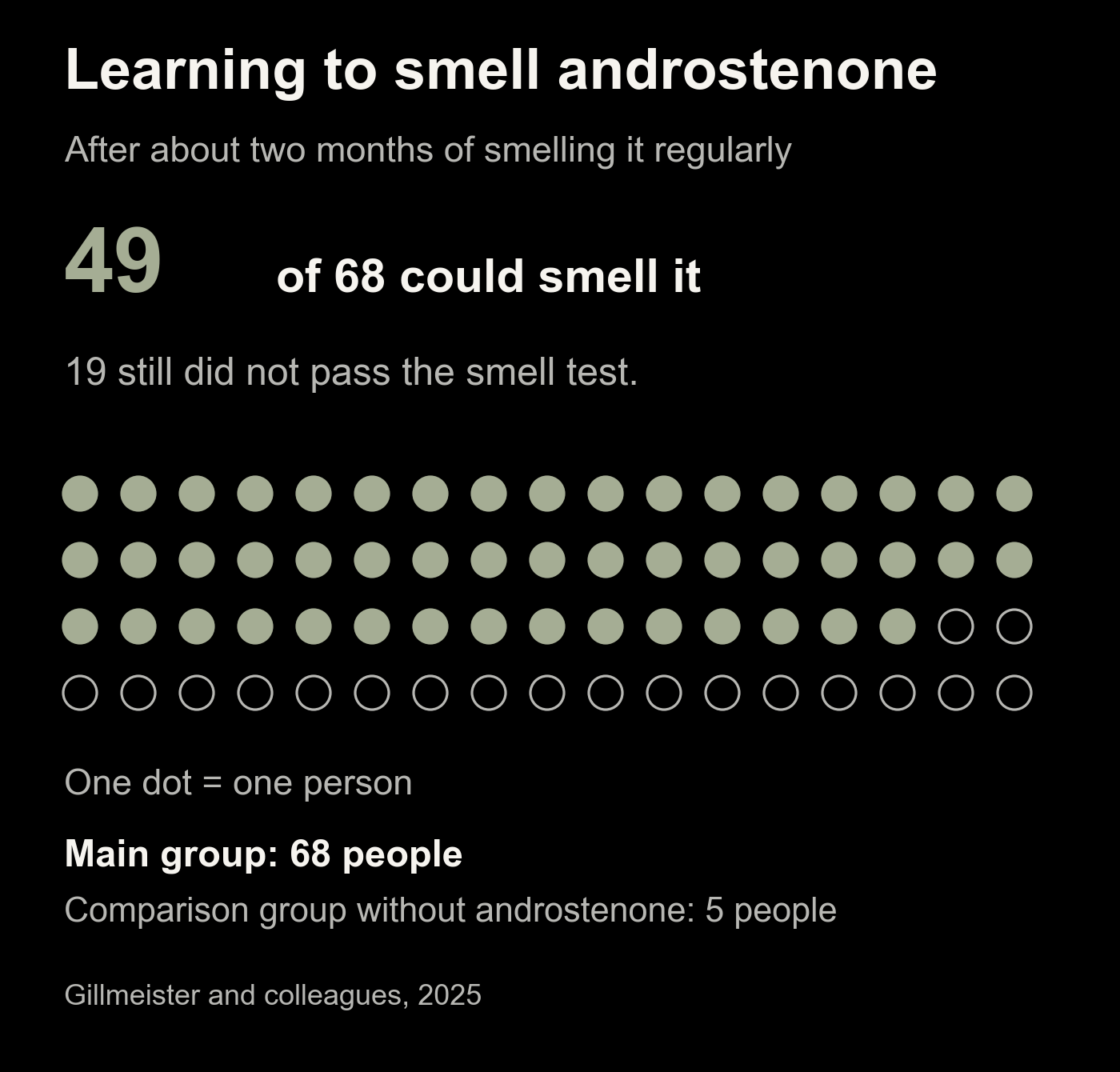
Gillmeister and colleagues’ 2025 study. The chart shows how many people in the main group could smell androstenone well enough to pass the test after training.66
Only five people trained with samples that did not contain androstenone, making the comparison group much smaller. This limits how firmly the study can credit the chemical exposure for the improvement. Still, a first smell test may not predict what someone can smell after repeated practice.7, 66
Researchers have also identified a receptor for the armpit acid HMHA. In a 2026 study, HMHA activated the human receptor OR52E8 in cells. The team used an engineered version of the receptor to study how the chemical fits into it. This adds a specific detection step to the chemistry of armpit odor.67
People vary in how strongly they smell these acids. In a 2019 study, some participants could not detect HMHA or 3M2H within the concentrations tested. Among women in Madagascar, those estimated to be in their fertile days rated HMHA as stronger. Their pleasantness ratings were similar. The study compared different women, so it did not follow each woman through her cycle.68
5.2. The vomeronasal organ
Many other animals have a small structure inside the nose called the vomeronasal organ, or VNO. It detects chemicals from other animals. Some adults have a small opening or structure in this area, but finding it has not shown that humans have a working system like those animals do. Some chemicals proposed as human pheromones can be detected through our ordinary sense of smell.1, 7
The debate includes experiments that delivered chemicals directly to this area. In 1998, Monti-Bloch and colleagues tested a lab-made steroid called pregna-4,20-diene-3,6-dione, or PDD. In the hormone experiment, ten men received PDD and a comparison liquid on separate days. The researchers reported lower LH and testosterone during PDD exposure. The chemical was delivered through a probe inside the nose over six hours. This tests a particular chemical and delivery method, while the route from the nasal tissue to the hormone response remains to be mapped.69
In one experiment, researchers temporarily blocked the area thought to contain the human VNO. This did not change the measured responses to AND compared with a procedure that left it unblocked. Tests of OR7D4 also show that an ordinary smell receptor can detect AND and androstenone.70, 7
A pheromone does not have to work through a VNO. What matters is whether one member of a species naturally releases a chemical that causes a particular response in another.12, 13
Women with one version of the VN1R1 gene scored higher on a questionnaire about casual sex in a 2017 study. The authors found a related result in a second group, but it depended on how they compared gene versions and accounted for relationship length. The study compared genes and reported behavior, without testing a smell or identifying an active chemical.71
5.3. Smells people do not notice
People can react to a smell without saying they noticed it. Researchers can check this by asking them to pick the odd sample out of several choices. If they repeatedly choose correctly, they can tell the samples apart even if they say they cannot smell a difference.21
Researchers sometimes add clove or musk to both the test sample and the control to hide a smell difference. This added scent can have effects of its own. They need to check that people cannot reliably tell the two samples apart.72, 73, 74
A 2014 experiment with moving dots tested AND and estratetraenol, or EST, using a 500-micromolar liquid mixture. That number describes how much chemical was dissolved in the liquid. It does not tell us how much people breathed in or whether someone’s skin would release a similar amount.75
Researchers need to measure both whether people notice a smell and whether it changes their reactions. A smell people do not notice is not necessarily more powerful.21
5.4. Hormones change the response to a smell
The person smelling an odor brings their own hormone state to the encounter. Fleming’s team studied 63 women after childbirth. Among 23 first-time mothers with both measurements, higher saliva cortisol went with more pleasant ratings of their own baby’s shirt. The link did not appear in mothers who had given birth before.76
Experiments with nasal sprays test whether giving a hormone changes the response. Maier’s team gave oxytocin or placebo to 58 people, including 30 women, before they smelled stress and exercise sweat from 30 men. With placebo, stress sweat made women see more fear in slightly fearful faces. Oxytocin reduced that bias and reduced the amygdala’s response to stress sweat in both sexes. Some men’s behavioral results came from exploratory comparisons. The oxytocin was given to the people smelling the sweat.77
Across five experiments with 216 men, Chen’s team tested oxytocin and vasopressin during AND or EST exposure. Men judged whether a walking figure made of dots looked male or female. With EST, a lower oxytocin dose increased the response in men reporting more social difficulties. A higher dose removed it. Men with fewer difficulties showed another pattern. Vasopressin did not produce the same changes. These were tests of movement judgments after hormone administration, without measuring natural oxytocin levels or attraction.78
Insulin can change odor detection too. A 2018 nasal-spray experiment with 30 adults found reduced sensitivity to n-butanol in 14 women, all taking the contraceptive pill. Men showed no change, and neither group changed its response to peanut odor. A 2019 study found improved n-butanol detection in 33 men. The studies used different doses and designs. They tested the ability to smell.79, 80
5.5. Tests with hormones themselves
Researchers have also put hormones directly in contact with smell tissue. Progesterone, estradiol and pregnenolone reduced responses to an odor mixture in tissue from female mice’s noses. Pregnenolone was applied in liquid. The authors considered whether its conversion to progesterone contributed to the effect.81
Testosterone activates TRPM8, a protein that lets charged particles cross a cell’s surface. Tests used purified protein, and researchers also found TRPM8 in the mouse smell system. Experiments linked the protein to mating, aggression and interest in urine. Those tests involved whole urine or encounters between mice, so they did not isolate testosterone released by another mouse as the cause.82
A human experiment tested testosterone, progesterone, estradiol and cortisol directly inside eight men’s and eight women’s noses. At the tested amount, responses resembled the control: electrical activity in the nose and skin, heart rate and breathing. Attraction was not measured. This was a small, single-blind study with authors working for or advising the sponsor.83
6. Body odor and sexual attraction
Several chemicals became candidates for human pheromones because of their structure, their effects in other animals or earlier scent claims. Researchers then tested people’s responses. Tristram Wyatt favors starting with a response to something people naturally release, such as sweat, and working backward to find the chemical responsible.84, 1
Testing a chemical on its own shows what it can do in that experiment. Measuring natural release and exposure helps establish when the same effect could occur in daily life.13, 9
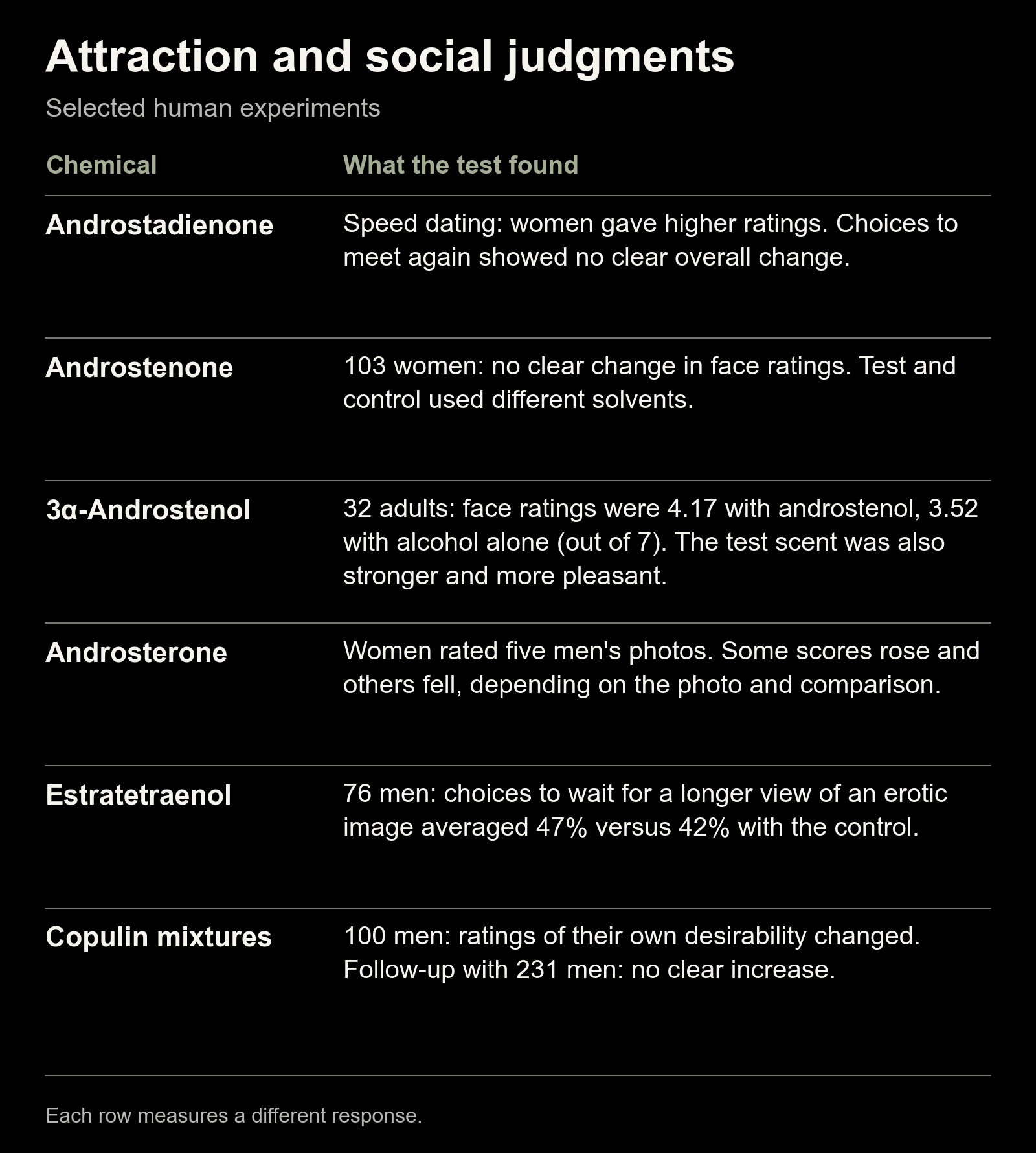
Examples of attraction and social judgments. Each row summarizes a different test. The following sections give the methods, comparisons and other findings for each chemical.72, 85, 86, 87, 88, 89, 90
Whole body odor has also been tested. In a 2004 Chinese study, 40 men and 42 women smelled shirts worn by three men and three women. Of the 82 receivers, 49 preferred the opposite-sex sample when choosing between male and female odors. The rest preferred the same-sex sample or made no choice. With only six scent donors, individual differences could strongly affect the result. No single chemical was tested.91
6.1. Effects of androstadienone
At three speed-dating events, women who smelled androstadienone, or AND, rated men as more attractive overall. Their choices to meet again showed no clear overall change. The groups were small and unequal in size, and results varied between events. Unilever funded the work.72
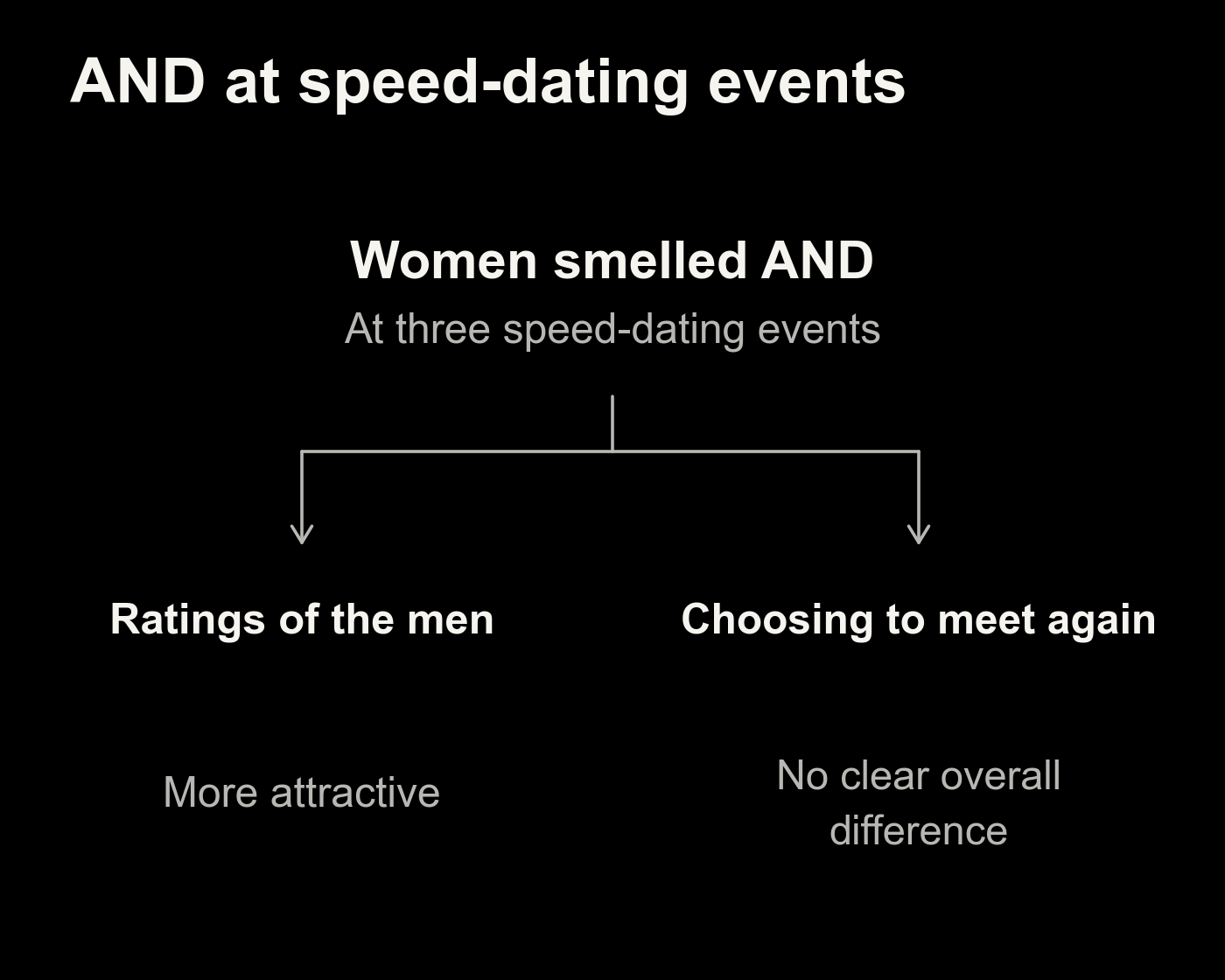
The speed-dating study measured both ratings and choices to meet again. Only the ratings showed a clear overall increase.72
The result depends on what people are asked to do. A 2017 study found no clear AND or estratetraenol effect on judgments of a face’s gender, attractiveness or likely unfaithfulness. A larger 2024 study found no clear AND effect on generosity or money-sharing with people at different levels of familiarity.73, 92
AND has changed cortisol, a hormone involved in energy use and stress, in opposite directions in different settings. Wyart’s team found higher cortisol after women smelled pure AND from a jar, compared with a similar-smelling yeast sample. They saw this in 21 women and again in another 27. Chung’s team found lower cortisol in 31 women doing timed arithmetic under critical feedback. They used dissolved AND on a pad, with musk in both samples. Delivery, comparison smells and the situation differed between the teams.8, 74
The person running the test may matter too. Among 37 women, mood improved with AND when a man ran the session, but the same pattern did not appear with a woman. Male-face ratings and attention did not improve. With only one experimenter of each sex, their individual manner could also explain the difference.93
A 2023 experiment tested punishment choices in 206 young heterosexual Han Chinese men and women. They smelled AND through a device at the nose before responding to an opponent they believed was the same sex. Men chose less aggressive punishments in two tasks. Women gave stronger punishments after provocation, with no clear increase in the other task. The study plan was not publicly recorded beforehand, and menstrual-cycle timing relied on the women’s reports.94
6.2. Androstenone and the androstenols
Androstenone occurs in human armpit samples and fluid from apocrine sweat glands. The receptor OR7D4 helps explain why people smell it differently.4, 7
In one older study, 14 women remaining from a larger group found androstenone less unpleasant around estimated ovulation. They still rated it unpleasant on average. Their ability to detect faint amounts did not clearly change. Another paper with competition and aggression in its title measured smell detection and ratings. A later correction changed a sensitivity statement and hormone-group labels. Aggressive behavior was not tested.95, 96, 97
Robin Tan’s doctoral study tested 103 women. Those smelling an androstenone mixture drank more alcohol-free beer during a taste test than those smelling water. Ratings of men’s photos and distance from a seat supposedly reserved for a man showed no clear change. The mixture contained propanediol, which was absent from the water control, so the solvent changed along with the steroid.85
3α-androstenol improved face ratings in a 2022 experiment with 32 heterosexual adults, sixteen of each sex. They sniffed the chemical in alcohol or alcohol alone before rating opposite-sex faces. Average scores were 4.17 versus 3.52 out of seven. The roughly two-second sniff came from a vial containing 1 mg per mL. Participants also found this sample stronger and more pleasant. The conscious smell experience therefore changed too. The experiment tested alpha-androstenol, and cannot establish the same effect for 3β-androstenol, its beta form.86, 36
An older necklace experiment found that women wearing 3α-androstenol later reported more conversations with men. It relied on their recollections, tested many questionnaire answers and contained some inconsistent reporting.98
In a toilet-stall experiment, men used selected stalls less often during the week when androstenol was applied to their doors. Androsterone produced no similar pattern in a different week. Fixed test order, untracked repeat visitors and amounts far above natural release make this a poor guide to ordinary contact.99
6.3. Androsterone and androstadienol
Androsterone changed how women judged men’s photos in a 1992 experiment. Maiworm and Langthaler studied 102 women using androsterone, androstenol and two control conditions. They applied a solution above the upper lip before the women rated five photos. Neither the women nor the researchers giving the tests knew which solution was used.87
The direction depended on the photo. With androsterone, one man’s average attractiveness score was 66.6 out of 100, compared with 51.8 in the group given no treatment. Another man’s score was 9.2, compared with 22.5. The authors reported both differences as statistically significant. They also used an alcohol-only control. For these two attractiveness scores, the table marks differences against no treatment, not against alcohol alone.87
Some other judgments changed against the alcohol control. One man was rated warmer and more lovable with androsterone. Another was rated less sexy. Androsterone affected impressions in this experiment, but the changes differed across the five photos. The authors recorded pill use and cycle timing without giving the group results needed to say that women on the pill were specifically repelled by androsterone.87
Androsterone also acts inside the body. Zolkowska and colleagues injected it into mice and measured protection against experimentally induced seizures. This is a measured nervous-system effect after a drug entered the animal’s body. Smelling androsterone released by another person is a different route of exposure.100
Researchers have followed androstadienol, or ADL, as it changes into other steroids in lab experiments. These reactions explain part of the production route shown in section 4.3.37, 38, 35
6.4. Effects of estratetraenol
The body can make estratetraenol, or EST. Human placental tissue converted AND into EST in a 1963 lab study. Researchers later identified it in late-pregnancy urine, checking it against a known sample and its chemical fingerprint. Most was attached to another chemical group and had to be freed with an enzyme. These findings concern production and urine content. They do not measure airborne exposure from skin.101, 102, 1
EST has changed some visual judgments. In 2014, AND and EST affected whether people saw a walking figure made of dots as male or female. Results differed by sex and sexual orientation. The later face study found no clear effect on gender or attractiveness ratings, using a different visual task.75, 73
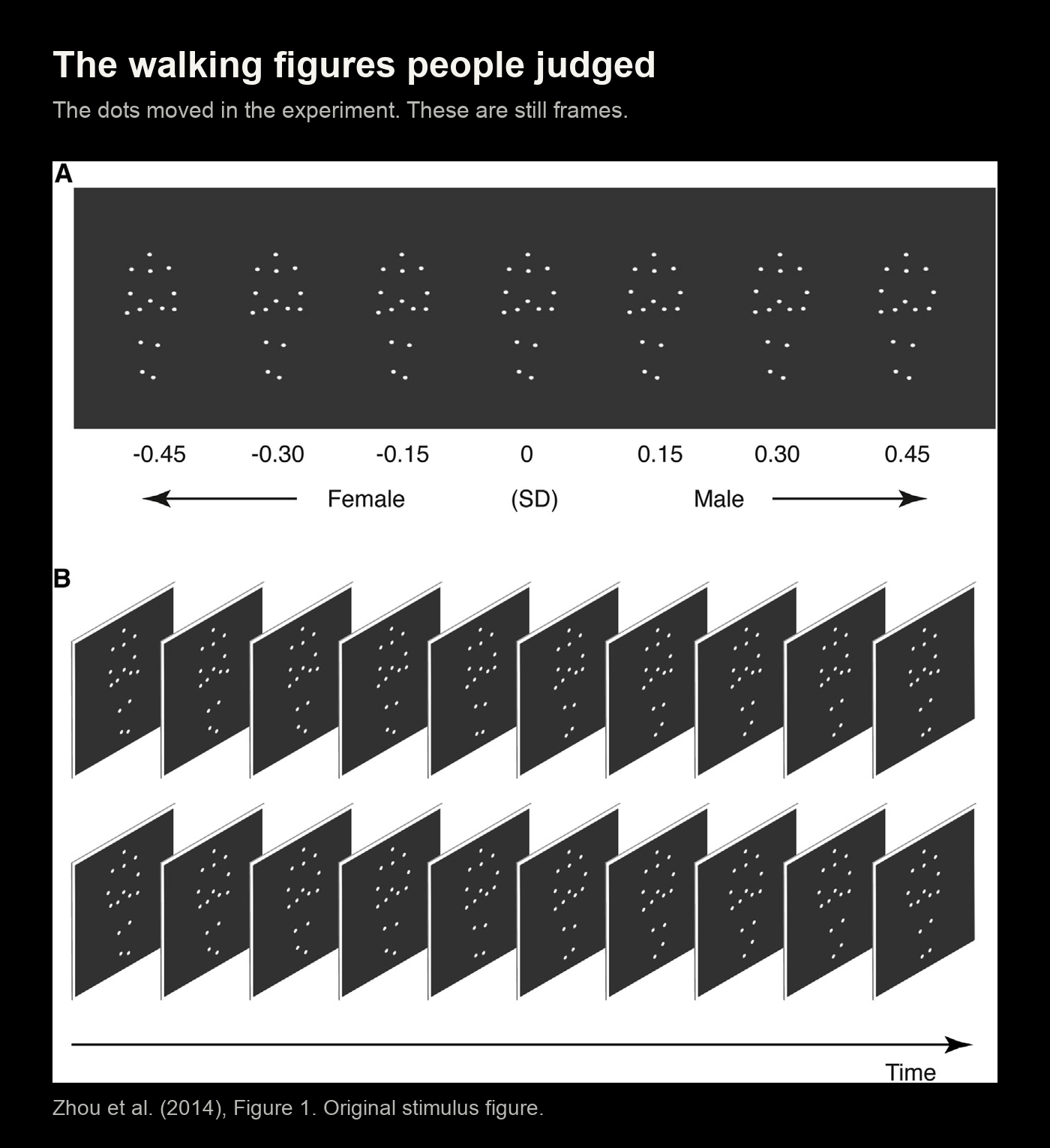
The actual figures used in the 2014 experiment. The top row shows the range from more female to more male body shapes. The lower rows show movement over time. SD is the paper’s unit for steps along the body-shape range, not a probability that a person is male or female. Original Figure 1 from Zhou and colleagues.75
Oren’s team tested a highly concentrated EST sample in two experiments. Among 56 men, it improved overall accuracy in judging relationships shown in videos. The result for intimate relationships alone did not remain clear after accounting for the number of comparisons. Another 64 men chose photos for an album about emotions. EST increased ratings for pictures of things touching, including objects as well as people, without a clear change across all pictures. Neither task measured romantic feelings toward a partner.103
The authors used a high concentration because natural exposure was unknown. A related paper tested cooperative decisions, possibly with some of the same participants.103, 104
Another study asked men to view an erotic image briefly now or wait to see it longer. Each completed the task with EST and a comparison scent. Among the 76 men analyzed, choices to wait rose from 42% to 47%. A separate measure of how waiting reduced the image’s value showed no clear change. Nineteen of the original 95 men were excluded, including seven who always chose the same option.88
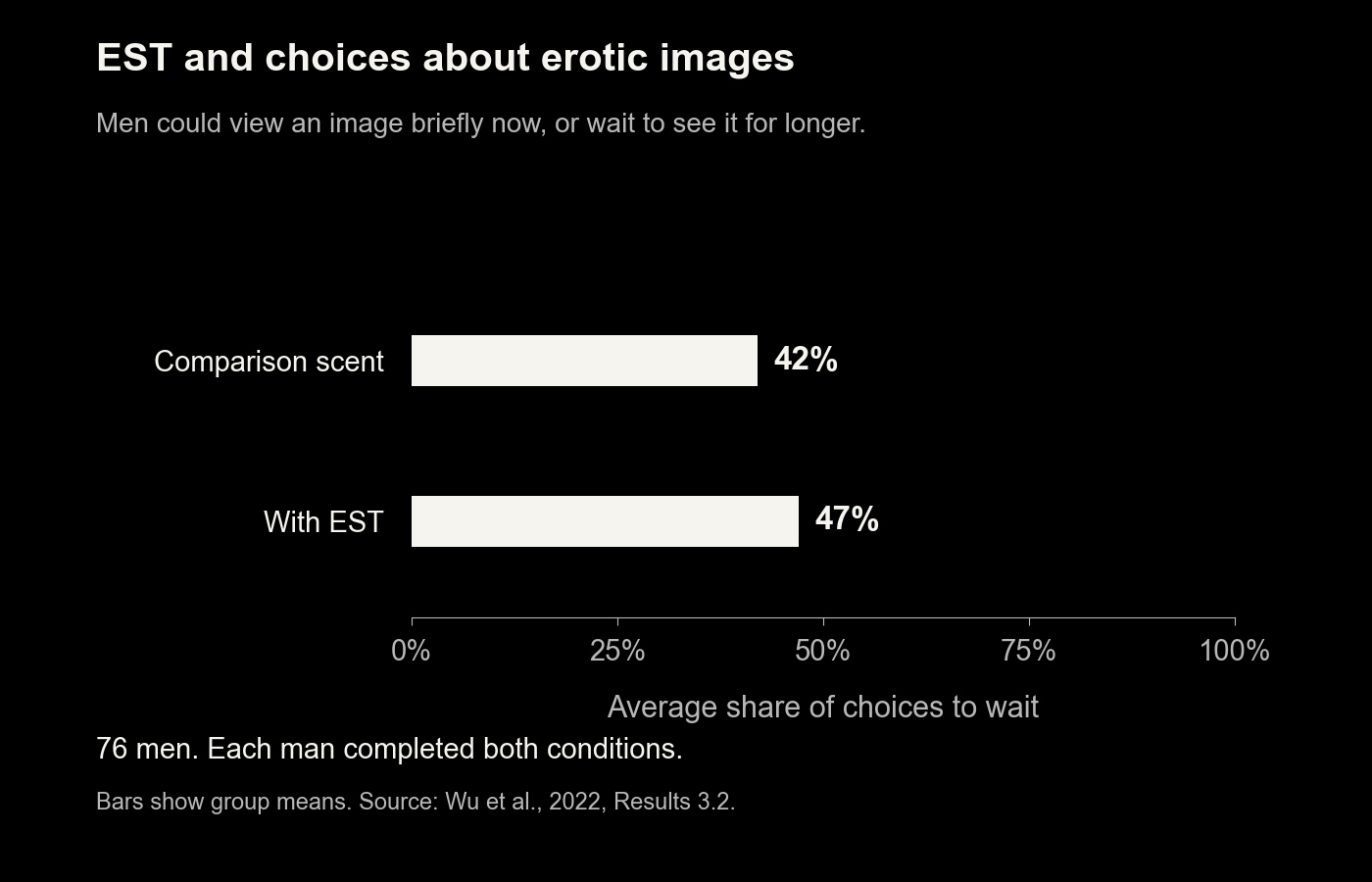
Average shares of choices to wait, from 0% to 100%. Each man completed both conditions. The task concerned viewing an image.88
6.5. Sexual orientation and brain responses
Brain scans have found different responses to AND in groups of men and women with different sexual orientations. A 2014 review describes experiments where changing the amount of AND also changed the apparent difference between men and women. Some older reports used the same comparison participants, so they include fewer separate groups of people than the number of papers might suggest.105
These scans describe average brain responses in the groups studied. They cannot tell us a particular person’s sexual orientation or what that person desires.105, 21
6.6. Copulins and vaginal acid mixtures
Copulins is a name for mixtures of short-chain acids found in vaginal fluid. Examples include acetic, propanoic and butanoic acids. In 1975, Michael and colleagues analyzed hundreds of samples collected across 86 menstrual cycles, including samples from women taking the pill. The amounts varied widely between women and with the collection method.106
Later teams tested lab-made versions of these mixtures on men. A 2016 study of 100 men found a difference in how desirable the men thought they were. The change in their ratings of women’s faces was too uncertain to count as a clear effect. Their reported efforts to keep a partner from becoming involved with someone else, called mate guarding, did not change. The study did not measure testosterone.89
A larger follow-up tested 231 men with four different sample conditions. It found no clear increase in efforts to find sexual partners, self-rated desirability, the expected changes in partner preferences or risk taking. The overall face ratings moved in the opposite direction to the predicted improvement.90
An older trial followed 62 couples through three menstrual cycles. They received an acid mixture or comparison treatments under coded labels. The study found no clear effect on sexual behavior or desire. A later analysis found a favorable result in a small subgroup when repeated days were counted separately. That result did not hold when each couple was counted as one unit.107
The acids themselves are known. The experiments used different recipes and ways of delivering them, with mixed results on attraction and sexual behavior.106, 89, 90, 107
6.7. Smell, arousal and sexual enjoyment
People with a more sensitive sense of smell reported more pleasant sexual experiences in a 2018 study by Bendas, Hummel and Croy. The researchers tested 70 adults with a rose-like scent and asked about their sex lives. Women who detected fainter smells also reported reaching orgasm during a larger share of sexual encounters. Sensitivity had no clear link to sexual desire, how often people had sex or how long it lasted. This was a comparison of existing differences between people. No body odor or pheromone was given to them.108
Wisman and Shrira collected women’s armpit sweat while the women were sexually aroused and while they were in a neutral state. Men then smelled the samples. In two of three experiments, they rated the arousal samples as more attractive. The third result was less clear. Other tests asked men how aroused they felt and measured their responses to photographs.11
McCarthy and colleagues checked the results in 2021 and found an error in the calculation of how large the effects were. The actual average differences in smell ratings were 0.18 to 0.27 points on seven-point scales. They also pointed out other inconsistencies in the original report.109
The changes were small, and the tests used whole sweat samples. They cannot identify which ingredient caused the change in ratings or show how it would affect a sexual encounter.11, 109
6.8. Seeing a man with a partner
Seeing a man with an attractive partner can change how another woman rates him. Liu and Zheng tested whether AND affected this response in two experiments published in 2026. Women first rated men’s faces, then saw the men paired with women and rated them again. Each participant did the task with AND under her nose and with a comparison scent on separate days.110
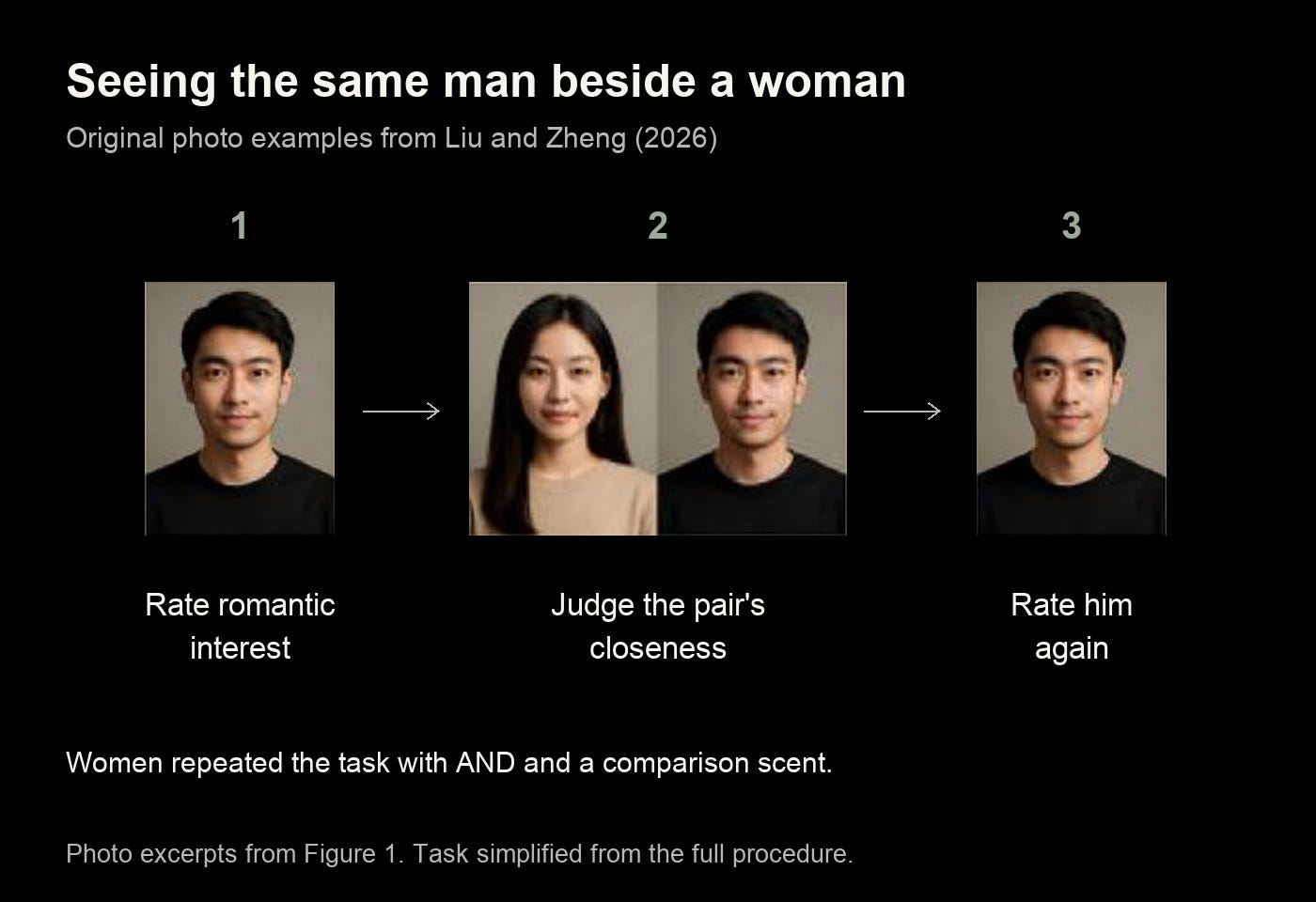
Women rated their romantic interest in a man, saw him beside a woman presented as his partner, then rated him again. These are the photo examples printed in the paper. The arrows show task order. Adapted from Figure 1 of Liu and Zheng, using its original photographs.110
In the first experiment, involving 54 women, the average increase in interest was about 0.55 points with the comparison scent and 0.12 with AND, on a seven-point scale. The difference was larger among women who reported less competition with other women. A second experiment with 50 women added a task that encouraged feelings of competition. The AND effect depended on that task and the women’s existing sense of competition. These experiments measured changes in ratings after viewing pictures. Some participant totals and statistical values in the paper do not agree, so its detailed subgroup results need particular care.110
7. Body odor, fertility and hormones
Hormones can matter on both sides of a scent experiment. A woman’s hormone levels may be linked to her body odor. The person smelling it has their own hormone levels, which may affect their response. Researchers can also test whether the odor changes those levels. For that last question, they need to compare the change after the odor with the change after a control sample.111, 96, 8, 112
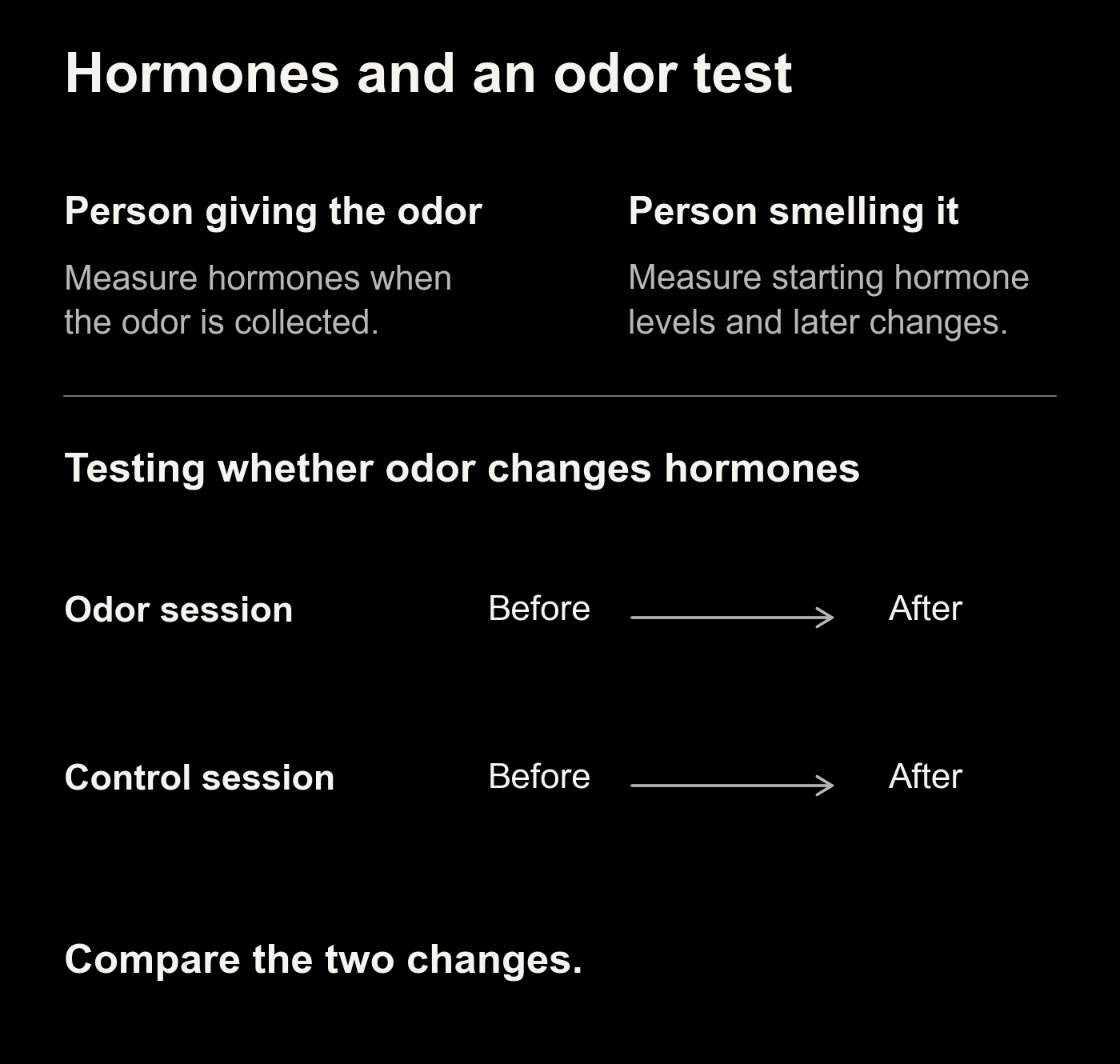
The sample giver’s hormone levels, the receiver’s starting levels and the receiver’s change after exposure are separate measurements. A change after an odor is only part of the comparison. Hormones can also change during the control session.111, 96, 8, 112
Men’s hormone levels can also be linked to the impressions their odor gives. In a Russian study published in 2012, 77 women smelled sweat samples from 29 men. Among women estimated to be near ovulation, sweat from men with higher testosterone and lower cortisol received higher ratings for reliability. That link did not appear in the group tested later in the cycle. The researchers measured the men’s hormones in saliva. The women smelled their sweat, and cycle timing was estimated from calendar dates.113
7.1. Body odor during the menstrual cycle
Men sometimes prefer a woman’s odor collected near ovulation, but the size and consistency of that preference vary. Gildersleeve’s team collected two armpit samples from each of 41 women, using urine tests to help confirm timing. Men chose the near-ovulation sample as more attractive on 56% of trials and distinguished the samples better than chance. The attraction result was less clear when each woman providing scent was counted separately, rather than each man rating it.114
Lobmaier’s team found higher scent-attractiveness ratings in women with higher estradiol and lower progesterone near their fertile days. This compared different women. Mei’s team took repeated samples from each woman, with hormone and ovulation tests. Average ratings changed near ovulation, but a woman’s hormone changes did not clearly predict her smell ratings. Men were also poor at identifying her fertile days from one sample.111, 115
A woman can smell attractive throughout her cycle. To find out whether her scent changes near ovulation, researchers need samples from her at different times.111, 115, 51
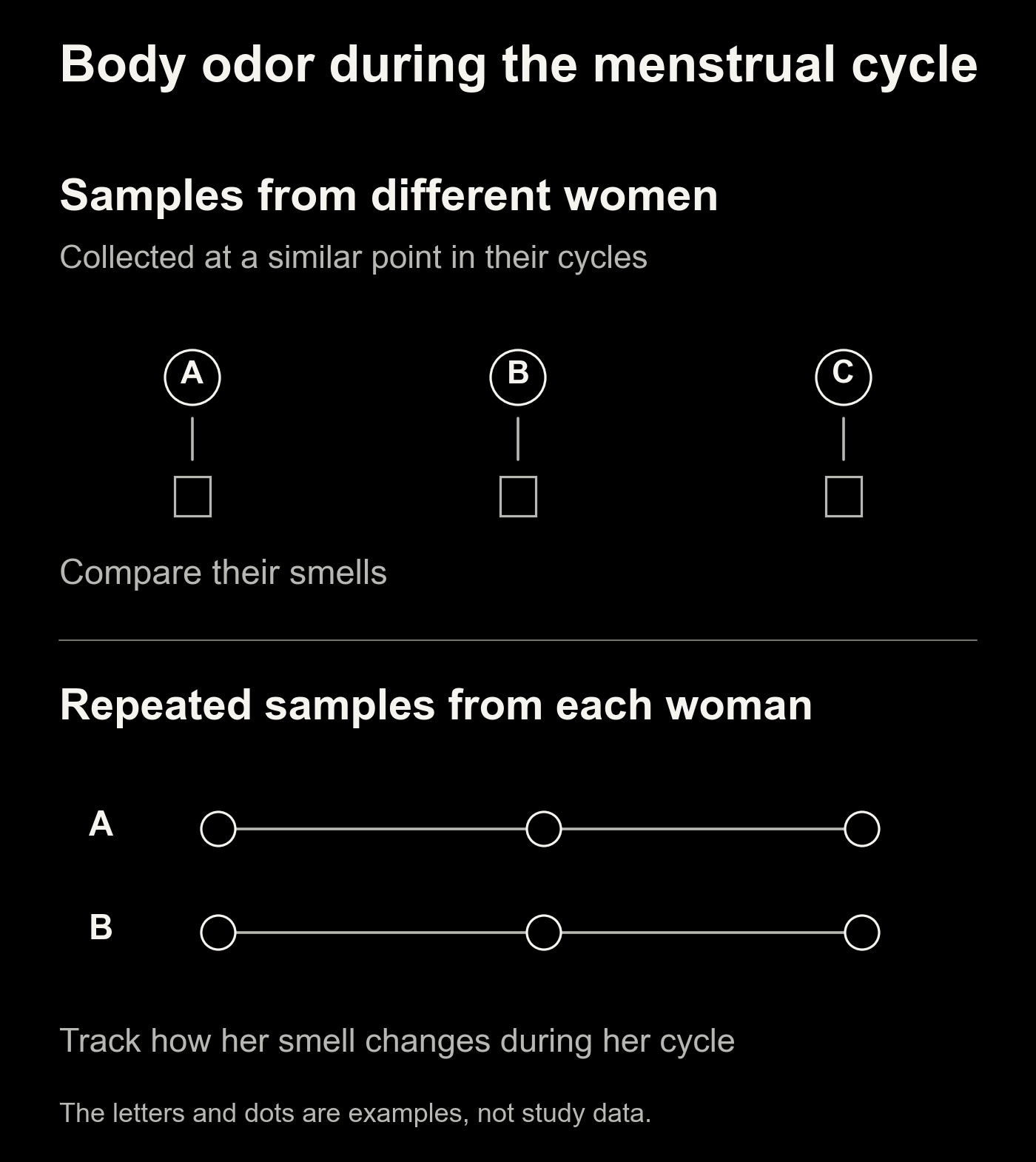
Comparing women and measuring a woman’s changes over time answer different questions. The dots illustrate the methods, without representing participant numbers.111, 115, 51
Zetzsche’s 2024 study combined repeated armpit samples, hormone measurements, ovulation tests, chemical analysis and smell ratings. It found no clear fertile-day improvement in attractiveness or the expected chemical changes.51
Ohgi’s team reported a positive result in 2025 with different collection methods. They identified geranylacetone, myristic acid and palmitoleic acid in connection with samples near ovulation. All three are outside the steroid group. Adding them to a lab-made armpit odor improved some ratings. Small further experiments tested mood, body reactions and face ratings.52
Many chemical comparisons were tested, increasing the chance of accidental findings, and the authors reported a related patent interest. The experimental blend also needs comparison with the amount men normally smell. Collection methods may explain part of the disagreement between the two teams.52, 51
A 2025 study examined odor from the vulva, the area around the vaginal opening. Ratings did not clearly improve during fertile days. Chemical patterns depended on the analysis and compliance with collection instructions. It used the same women as Zetzsche’s armpit study, adding a second body area within that group.116, 51
7.2. Hormone changes after smelling body odor
Studies of men’s testosterone after they smell women’s body odor have produced mixed results. Tarumi and Shinohara used samples from five women and reported effects for some body areas. Roney and Simmons found no testosterone effect after confirming when the women ovulated and repeatedly measuring men’s saliva. Another study of scents from fertile days found none of the expected hormone or psychological changes.117, 118, 119
Preti and colleagues gave 18 women a mixture of men’s armpit samples to smell, along with a control whose smell was masked. The order varied between sessions. The average wait until the next release of luteinizing hormone, or LH, was 47 minutes after the men’s samples and 59 minutes after the control. The number and size of these hormone releases, and the starting LH level, showed no clear difference.120
LH helps control reproduction. The body releases it in repeated bursts, often called pulses. The large rise around ovulation is different from the timing of one pulse. Preti’s result concerns a 12-minute difference in that timing. The team tested the combined armpit samples, so identifying the ingredient behind the change would need a further test.51, 120
Shinohara and colleagues also measured LH pulses in studies involving 11 and 20 women. They tested androstenol or armpit extracts. In the 20-woman study, the results depended on when in the sample-givers’ cycles the armpit material had been collected.121, 122
7.3. Scents from breastfeeding women
Jacob and colleagues studied whether scents collected during breastfeeding affected other women’s menstrual cycles. The samples came from the armpits and breasts of 26 nursing mothers and could also contain their babies’ saliva. Women in the experiment wiped the samples, or a comparison liquid, under their noses several times a day for two cycles. In the main analysis of 47 women, cycle lengths became more spread out in the scent group. Women who began with longer cycles tended to keep longer cycles, while those with shorter cycles tended to keep shorter ones.123
Spencer and colleagues reported sexual-diary results from the same larger experiment. Women receiving the collected scents reported increased sexual desire and more days with sexual fantasies. Sexual activity did not clearly increase. These papers describe overlapping participants, so they add different measurements from one research project.124, 123
The cycle analysis excluded women whose starting cycles fell outside the study’s chosen range. The diary analysis also excluded some missing or extreme values. Both results concern repeated application of collected fluids under the nose. Neither paper identifies a single ingredient responsible for the changes or shows that ordinary contact with a nursing mother has the same effect.123, 124
7.4. Menstrual cycles in women living together
Menstrual synchrony is the idea that women who live together or spend time close to one another begin getting their periods at the same time. A 1971 dormitory study tracked when women’s periods started. In 1998, Stern and McClintock tested armpit extracts collected at different points in women’s cycles. That experiment compared extracts containing a mixture of chemicals.125, 126
Yang and Schank followed 186 women in 29 dormitory groups. Their periods did not stay aligned beyond what would be expected by chance. Cycles of different lengths naturally bring period dates closer together and then further apart. Matching dates can happen without one woman’s body changing another’s cycle.127
A change in the timing of one LH pulse would need to produce repeated changes across whole cycles to explain periods staying aligned. The synchrony studies have not established that chain or identified a chemical that causes it.126, 127, 1
7.5. How reproductive fluids act on sperm
Progesterone released by cells around the egg acts directly on human sperm through fluid. It lets more calcium enter through CatSper, a channel in the sperm’s surface, and changes tail movement.128, 129
Jeschke’s team tested 15 steroids, including pregnenolone, testosterone, DHEA, estradiol, estrone and cortisol. All caused calcium entry, with widely different strengths. Responses disappeared in sperm lacking a working CatSper channel. Progesterone and 17-hydroxyprogesterone were strongest. The team also tested fluid from around eggs, chiefly a pooled sample from four women undergoing fertility hormone treatment. At the much greater dilution expected in the reproductive tract, they judged progesterone likely to explain most of the fluid’s effect.130
Semen contributes prostaglandins, chemical messengers that also activate CatSper. Zinc held the response down. Diluting a mixture of zinc and prostaglandin E1 first strengthened the calcium response, then weakened it with further dilution.130
Wehrli’s team screened 90 steroids and examined ten active examples more closely, including pregnenolone, testosterone, epiandrosterone and deoxycorticosterone. They increased calcium inside sperm and reduced the response to progesterone added later. The ten did not change overall swimming measures.131
How progesterone starts the response remains disputed. Miller’s team proposed in 2016 that it activates ABHD2, an enzyme that breaks down a fat-like substance holding CatSper down. Edwards’s team used more selective ABHD2 blockers in 2026, and sperm still responded to progesterone. This challenges that proposed enzyme step.128, 129
These are direct effects of hormones in reproductive fluids. Attraction through smelling them was not tested.130, 131
8. Body odor and relationships
8.1. Immune genes and partner preference
Some partner-choice research focuses on genes that help the immune system recognize what belongs in the body. They form a group called the major histocompatibility complex, or MHC. In humans, this group is called HLA. One idea is that smell helps people choose partners with a useful difference in these genes.132, 1
In the 1995 T-shirt experiment, Wedekind and colleagues asked 49 women to smell shirts worn by men with similar or different HLA types. The 31 women who were not taking the pill rated the smells of men with different HLA types as more pleasant. The 18 pill users showed a preference in the other direction in one analysis, though it was less clear when each woman was counted separately.133
A 2018 experiment included smells from both partners and strangers. Among the 24 women who were not using hormonal contraception, scents from men who shared more of the tested HLA types received lower attractiveness ratings. The 28 women using hormonal contraception and the 47 men showed no clear preference based on this similarity.134
Researchers have tested several versions of the idea. A person might prefer someone with different gene versions, a wider variety of versions or a particular combination. Studies also measure different things: whose smell people like, how satisfied couples are or which gene combinations actual couples have.132
A review combined results from several studies and examined these questions separately. Overall, it found no clear link between having different MHC genes and the preferences or relationship outcomes measured. Some individual studies found links, but the combined results do not give a reliable rule for choosing a compatible partner by smell.132
A Brazilian study published in 2026 included 20 heterosexual and 20 non-heterosexual men who rated other men’s armpit odors. The non-heterosexual men gave the male scents higher attractiveness ratings. HLA similarity did not explain those ratings, though more similar HLA types were associated with stronger-smelling samples. The paper draws on Silva’s earlier thesis, so the thesis and article share research rather than providing two independent tests.135
Milinski and colleagues added HLA-related peptides, small chains of amino acids, to people’s own armpit odor. Among 17 nonsmokers tested while free of a cold, people preferred the altered scent that matched their HLA type. They were judging which smell suited them. The researchers knew which peptides they had added, but did not measure how much would naturally pass from one person to another.136
8.2. Birth control, smell and face preferences
In one study, 37 women who started taking the pill and 60 comparison women repeated smell-preference tests over time. After starting the pill, the women’s preferences shifted toward men whose immune genes were more similar to their own, relative to the comparison group. The women chose for themselves whether to start the pill. Beforehand, the study found no general preference for men with different HLA genes.137
This study followed women starting the pill. It did not follow women stopping it or test androsterone. Its group result cannot predict how one woman will feel about her partner’s smell.137
Another study gave women weekly smell tests. Thirteen pill users had a test during their scheduled break from active pills. On those days, they were less able to tell body odors apart than during weeks when they took active pills. Across the study as a whole, pill users and women who did not take the pill performed similarly.138
Telling two body odors apart is different from noticing a very faint smell. Some other studies tested the faintest amount women could detect. These different tests of smell can give different results.138, 139
Thorne and colleagues studied 32 women, half of whom took the pill. Women rated male faces and fictional characters more favorably overall when a combined sample of men’s armpit odor was present. Pill use did not clearly change the effect on face ratings, and pill users also gave higher scores to some characters. The study was small, used few visual examples and compared the scent with a room without added odor. Even so, it found positive responses among pill users, which goes against the idea that they generally dislike male scent.140
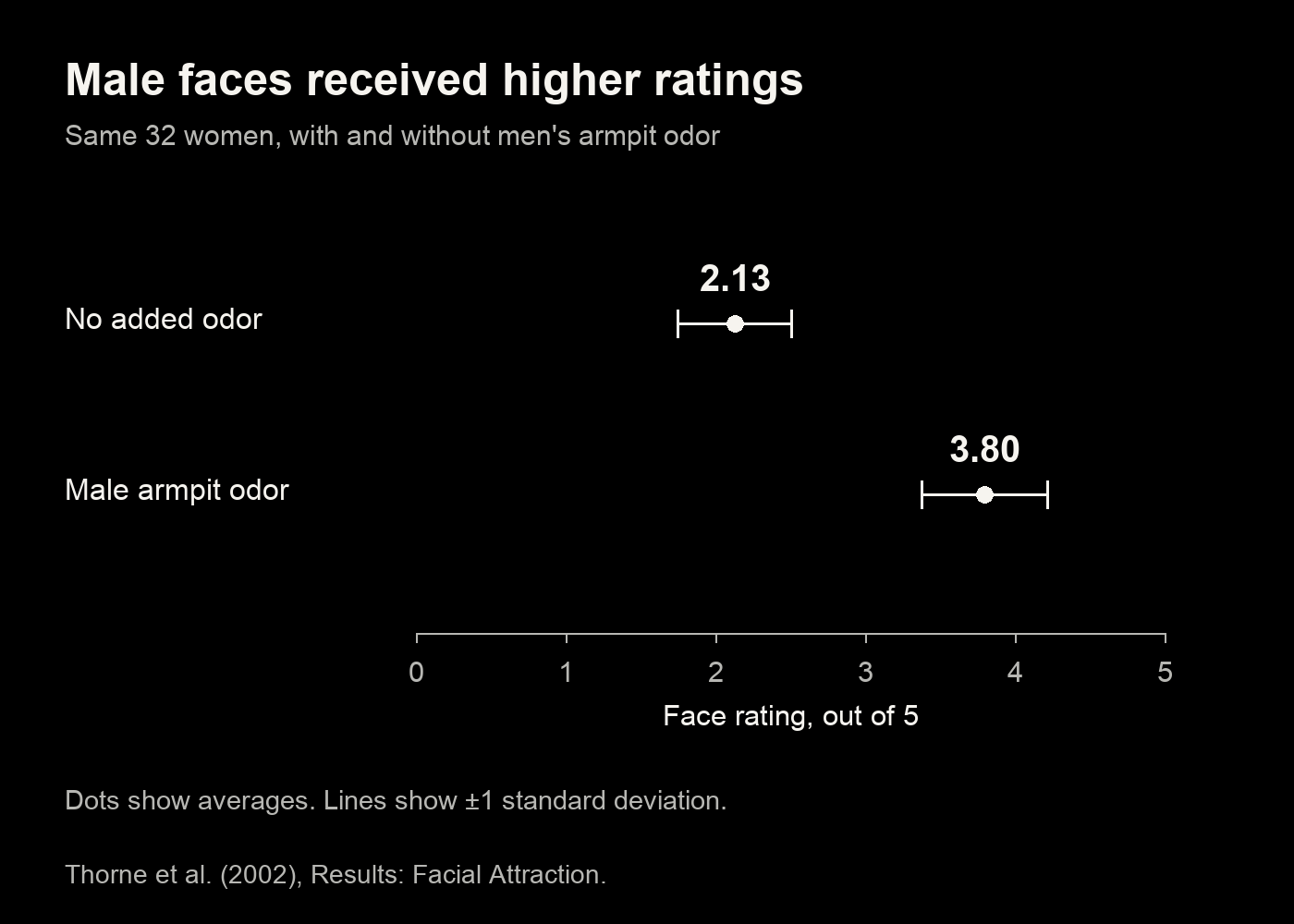
Ratings from all 32 women, including 16 pill users. Each woman completed both odor conditions. Dots show averages. The short lines show the spread reported for each condition, expressed as one standard deviation. Redrawn from the numbers in Thorne and colleagues’ Results section.140
A 2026 study tested 98 women twice, including 47 pill users. It found no overall difference between pill users and other women in detecting, identifying or telling smells apart. Some smaller groups differed depending on the pill and how it was taken. These were tests of ordinary smells. They did not test attraction to men’s body odor or a response to androsterone.141
The pill has also been studied through the faces women choose. In 2013, Little and colleagues let women adjust men’s faces on a computer until they looked most attractive. Among 18 women who started the pill, preference for a more masculine face fell relative to 37 women who stayed off it. The women chose whether to start the pill themselves.142
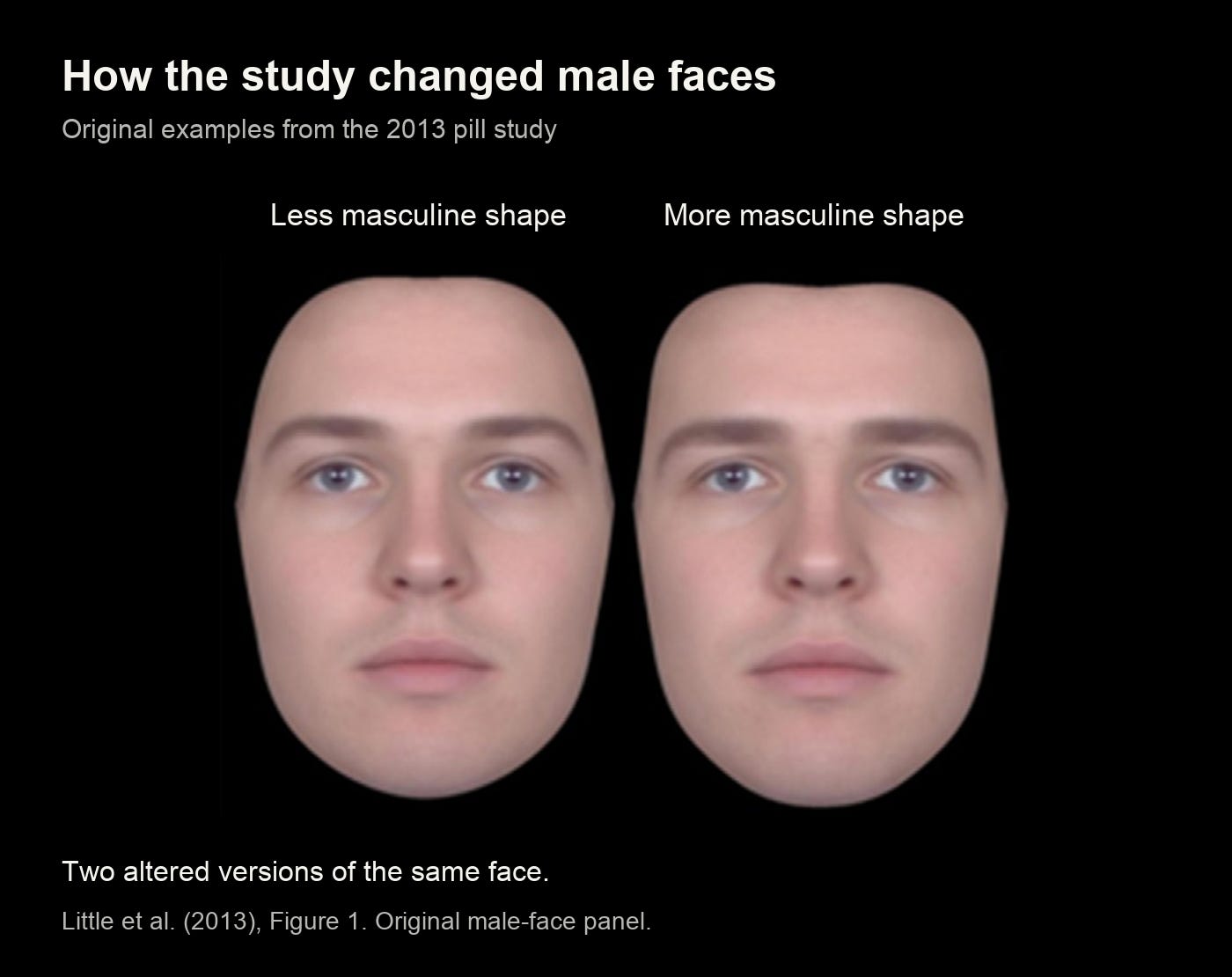
The male-face examples from Little and colleagues’ Figure 1. Women adjusted face shape along a range between the two versions. These images show what the researchers meant by facial masculinity.142
A separate comparison in the same paper included 170 couples. Half the women had been taking the pill when their relationship began. Their partners’ faces were judged less masculine on average than those of the other group. The pictures below are computer-altered examples built from the two groups’ average face shapes. The couples were already together when studied, so this comparison cannot show how the pill changed any one woman’s choice.142
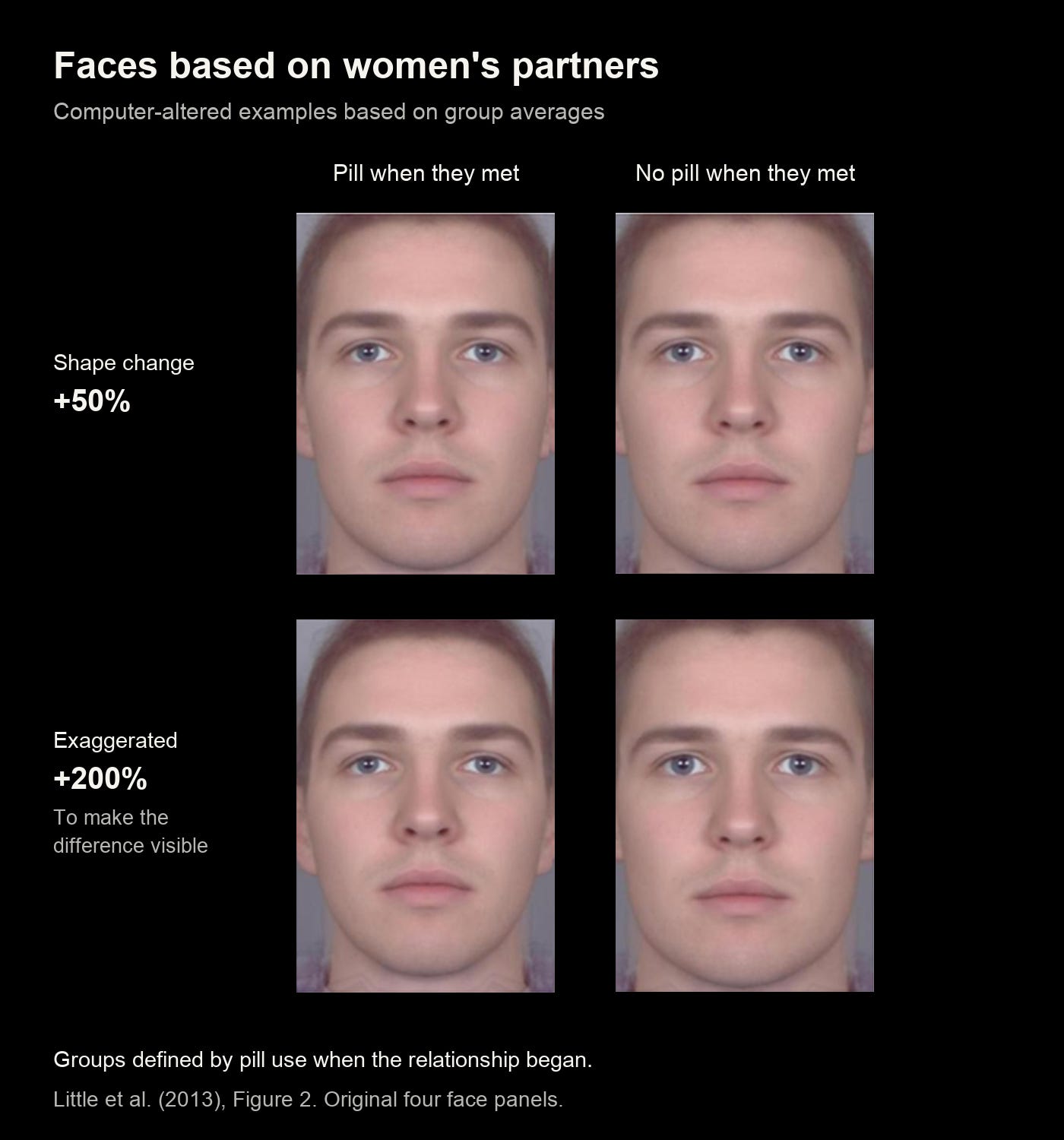
The original face panels from Figure 2. The left column uses the shape associated with partners of pill users, the right with partners of nonusers. The top row uses +50% shape changes. The authors exaggerated these to +200% in the bottom row to make the difference easier to see. These percentages describe image editing, not hormone levels.142
A later study by Jones and colleagues followed 30 women who started the pill and 15 who stopped. It found no drop in preference for masculine male faces during pill use. The 2013 pattern therefore did not carry over to this later group. These experiments tested visual preferences. They did not measure the men’s scent or testosterone.143, 142
8.3. Dominance and responses to other women
In 2025, researchers measured men’s testosterone and asked other people to rate the smell of shirts the men had worn. Men with higher testosterone were judged as more dominant. Higher testosterone had no clear link to ratings of sexiness, a pleasant smell, or being worthy of respect and admiration. A correction to the paper clarified which university had recruited the participants.144, 145
An earlier study also found no clear link between men’s testosterone and how attractive their body odor smelled. Seeming dominant, seeming attractive and acting aggressively are different things. The 2025 study measured impressions from shirt smells. It did not measure androsterone or watch men interact aggressively.146, 144
Experiments with a named chemical give a different kind of evidence. Banner and Shamay-Tsoory tested 64 men with AND and a comparison scent on separate days. Men with higher social anxiety rated male faces as slightly more dominant with AND. Their average rating rose from 4.82 to 5.06 on a nine-point scale. Men with lower social anxiety showed no clear change. The chemical altered how one group judged the faces.147
Rivalry has also been studied in women. In a 2026 experiment, 52 women read a story in which another woman was interested in the same man. With AND, they rated the other woman as more flirtatious and said they were slightly more likely to share negative information about her. The average likelihood score rose from 3.00 to 3.19 on a seven-point scale. Positive and neutral gossip scores did not clearly change. These were answers about an imagined situation, and the negative information was specifically about sex and fidelity.148
A different 2026 study, by Nehls and colleagues, tested 33 women with body odors collected from other women during menstruation, near ovulation or during pregnancy. While smelling pregnancy samples, participants chose a greater preferred distance from women shown in photos than while smelling either of the other body-odor samples. Their attractiveness ratings did not change. The distance was a choice on a screen. The photos showed different women from those who gave the odors.149
The researchers tested the collected odors as mixtures. Hormone measurements helped identify the donors’ and participants’ reproductive states. The experiment did not isolate progesterone, estradiol or another hormone as the chemical responsible.149
8.4. Recognizing people by smell
A worn shirt carries body odor along with smells from the fabric, soap and perfume. Researchers have tested whether partners, mothers and babies, and children who know each other can recognize one another by smell. These tests ask whether a scent is familiar. Attraction tests ask whether someone likes it.1, 150
With relatives, both shared genes and time spent together may matter. A familiar family smell could come from similar body chemistry, from learning someone’s smell, or both. Researchers need comparisons that separate these explanations.13, 1
A partner’s smell has also been tested during sleep. Hofer and Chen asked 155 people to sleep with shirts used as pillow covers, including a shirt worn by their partner. Wrist monitors estimated how much of their time in bed they spent asleep. Across the three groups studied, the average improvement with the partner’s scent was about two percentage points. The first group showed the clearest result. Neither of the two later groups showed a clear improvement on its own, including the group that compared partner odor with a stranger’s odor. The experiment tested the whole familiar scent.151
A partner’s scent does not always feel calming. In a 2026 lab study, people who smelled their romantic partner’s odor reported more stress and had a higher heart rate. Their cortisol did not fall.152
8.5. Body odor and smell at different ages
Sweat glands, hormones and experience change with age. Much human scent research uses young adults, so studies of children and older people add information those experiments cannot supply. Soaps, perfumes, culture and expectations affect people’s experience of odor too.1, 24, 21
Among 219 Czech children aged ten to fifteen, 109 named someone who smelled good. Within that group, those further through puberty more often named other young people than adults. Their answers included perfume and deodorant.153
A 2026 study followed 276 women through pregnancy and after birth with repeated questionnaires. Disgust ratings for situations involving body odor were highest early in pregnancy and lowest seven to eight weeks after birth.154
Among 2,086 Americans aged 62 to 90, AND detection was linked to aspects of social and sexual life. This compared existing differences between people, without testing whether AND exposure changed their lives.155
Japanese research also describes the sweet-smelling γ-decalactone and γ-undecalactone, or lactones C10 and C11. A Rohto patent reports higher amounts in clothing samples from younger women in a group of 50. Separately, 52 adults gave women’s photos higher youthfulness, femininity and attractiveness ratings with a perfume containing the lactones than without fragrance. That comparison cannot isolate each lactone’s contribution.156
In a 2025 menopause study, a difference in faint-odor detection disappeared after accounting for age. Some differences in identifying smells remained. Sexual responses were not tested.157
Detecting faint odors, recognizing someone and finding their smell attractive are separate abilities. A result in one age group does not describe all three across life.1, 105, 155
9. Communication beyond attraction
9.1. Smell between parents and babies
Newborns respond to several smells associated with feeding. Montgomery’s glands, the small glands around the nipple, release fluid during breastfeeding. When Doucet’s team held samples near babies’ noses, their breathing and mouth movements changed, suggesting a role in early feeding responses.2
Other experiments traced particular chemicals. Contreras’s team found eight fatty acids in amniotic fluid, the liquid around a baby before birth, and in early and later milk. Nineteen newborns made longer sucking movements when smelling amniotic fluid or a lab-made mixture of the acids than comparison samples.158
Gutiérrez-García’s team tested each acid separately in 12 newborns. Myristic acid produced longer sucking and sniffing movements than the other acids, salt water, vanilla or the solvent. Samples were held near the nose for 30 seconds, and two people scored recordings without knowing the sample used.159
These babies had already fed, so familiarity before birth or during feeding could contribute. Sleep state was not recorded in the 2017 study. Both studies measured movements, rather than milk intake. They also leave a separate question about which ingredients cause the response to Montgomery’s gland fluid.158, 159, 2
Androstenone solutions produced some negative facial responses or shorter positive movements in a study of 81 newborns. The main scorer knew the samples used, and the preparation contained a second, weaker odor. The experiment tested these solutions, without removing androstenone from milk to check its role there.160
Parents respond to children’s odors too. Two 2024 brain-scan studies included 78 women. Younger children’s odors produced stronger responses in areas linked to pleasure and reward. Some connections between brain areas differed with motherhood, and certain connections were stronger when mothers smelled their own young child than an unfamiliar child.161
A University of Tokyo patent reports tests in 133 mothers whose youngest child was three to five. Two infant-odor mixtures produced larger urinary oxytocin increases than three comparison conditions. The smaller mixture contained 2-pentylfuran, 2-pyrrolidone, acetophenone, phenylacetaldehyde and nonanal. The inventors measured urine oxytocin, without testing childcare behavior.162
A 2025 Japanese study gave 27 mothers a 14-compound infant-odor mixture while they heard babies’ cries and happy sounds. After accounting for multiple comparisons, the main brain-response test showed no clear odor effect. A further analysis found a difference linked to ratings of cries. The ratings themselves did not change.163
An Iranian trial followed 78 mothers with babies in intensive care for five days. Watching a video of their baby, with or without smelling the baby’s worn hat, reduced reported anxiety and increased expressed milk compared with receiving a plain hat. Adding the odor showed no clear extra benefit over the video alone.164
9.2. Body odor during fear
Sweat collected during fear can change other people’s responses to faces and threats. A 2017 meta-analysis, which combined 26 experiments, found an overall pattern of responses. The tasks and collection methods differed. A change in attention or face judgment need not mean the person consciously feels afraid. Movement, warmth and sweat volume can change during fear too.3, 21
Researchers have tested particular chemicals. In a 2023 study, the main sweat results failed to match predictions recorded before analysis. Later patterns in smaller groups led to a test of palmitic acid, also called hexadecanoic acid, in 33 women. It made them slightly more likely to label mixed fear-disgust faces as fearful than the other conditions combined. The acid occurred in neutral sweat too, and the test used an added amount. Its contribution at natural body-odor levels needs a separate comparison.165
A 2025 study collected sweat from 12 women during anxiety-provoking dental treatment and a neutral night at home. Strong odor ingredients included decanoic acid, lauric acid, myristic acid and HMHA. Lauric acid and HMHA stayed detectable at greater dilution in anxiety samples. Myristic acid showed the reverse. These were measures of odor strength in extracts, not exact amounts in fresh sweat, and HMHA’s identity was tentative.166
After smelling the anxiety sweat, 36 men and women detected a fainter rose-like smell than after an unused pad. The difference from neutral sweat was unclear, and a second test odor showed no improvement. Collection duration and setting also differed between the sweat samples. The receiver test used the whole mixture, so it cannot assign the response to one acid.166
A 2026 preprint measured chemicals above the armpits of 37 adults during frightening virtual scenes. Stronger fear responses went with more acetic, butyric, caproic and caprylic acids, octanal and acetone. Sulcatone, decanal, geranylacetone and citraconic anhydride showed the reverse pattern. Some identities were tentative because similar chemicals can overlap in the measurements. Everyone saw the neutral scene first, allowing time effects to contribute. Other people’s responses to this mixture were not tested.167
9.3. Body odor during happiness
In 2015, de Groot and colleagues asked 35 women to smell sweat from nine men who had watched happy, frightening or neutral films. Sweat collected during the happy films caused facial-muscle activity that the authors interpreted as smiling. In a separate test, it did not make the women judge neutral symbols more positively.168
This was an early study looking for possible effects. The smiling result depended partly on how the researchers handled differences in muscle activity between women. All men watched the film types in the same order, so the order could also have affected their sweat. Unilever partly funded the work. The tests measured immediate reactions during the session.168
9.4. Illness can change body odor
In a 2023 experiment, people received either a bacterial substance called lipopolysaccharide, which causes inflammation, or salt water as a control. Other people then smelled their body-odor samples. They rated the samples collected after inflammation as slightly less pleasant.169
The researchers also found a change in 6-methyl-5-hepten-2-one after accounting for the many chemicals they had compared. They tested the collected odor as a whole, so this chemical change does not explain the less pleasant ratings by itself. They measured ratings of samples, without watching whether people avoided an ill person.169
9.5. Experiments with human tears
Smelling tears has changed sexual responses and retaliation in several experiments. Gelstein’s team collected tears from crying women in 2011. Twenty-four men rated women’s photos as less sexually attractive after smelling tears than salt water, without seeing anyone cry.170
Other experiments reported lower arousal and testosterone. Brain areas first identified by their response to sexual images were less active during sad films after tears than salt water. Some hormone and arousal findings, however, came from separate before-and-after tests. A decrease after tears alone does not establish that it differs from the change after salt water.170, 171
A Korean team directly compared those changes in 2012. Sixteen men provided usable testosterone measurements on separate tear and salt-water mornings. Blood testosterone fell 28.6% after tears and 14.0% after salt water, a statistically significant difference. Four of the original 20 men’s samples were excluded because of damage. Appetite and food intake did not change.112
The attraction finding has been harder to repeat. Gračanin’s team ran three studies with 75, 150 and 28 men, finding no clear overall reduction in attractiveness ratings. Their images, tasks and some methods differed. Noam Sobel disputed those methods and found decreases after reanalyzing one face and one subgroup. These were selected parts of the same data, rather than new independent experiments.171, 172
In 2023, men played a game against someone they believed was stealing their money. They could retaliate by taking money from the opponent without keeping it. Among 25 men analyzed, retaliation per theft was lower after smelling women’s tears than salt water.10
Four human smell receptors also responded to tears in lab-grown cells. The tests show detection of ingredients within the mixture, without identifying which ingredient explains the game result. The authors proposed that tears could protect babies, but their experiment measured adult men’s retaliation and did not test infant care.10
9.6. Hexadecanal and aggression
Hexadecanal, or HEX, is a different chemical from hexadecanoic acid. Mishor and colleagues tested it in 127 people. After a game with an unfair opponent, participants chose how loudly to blast noise at that person. Compared with their respective control groups, men who smelled HEX chose quieter noise and women chose louder noise.9, 165
The authors suggested that HEX might help protect babies. That idea went beyond the experiment, which involved a game. The team did not study parents caring for babies. The study also left open how much HEX people normally release and breathe in.9
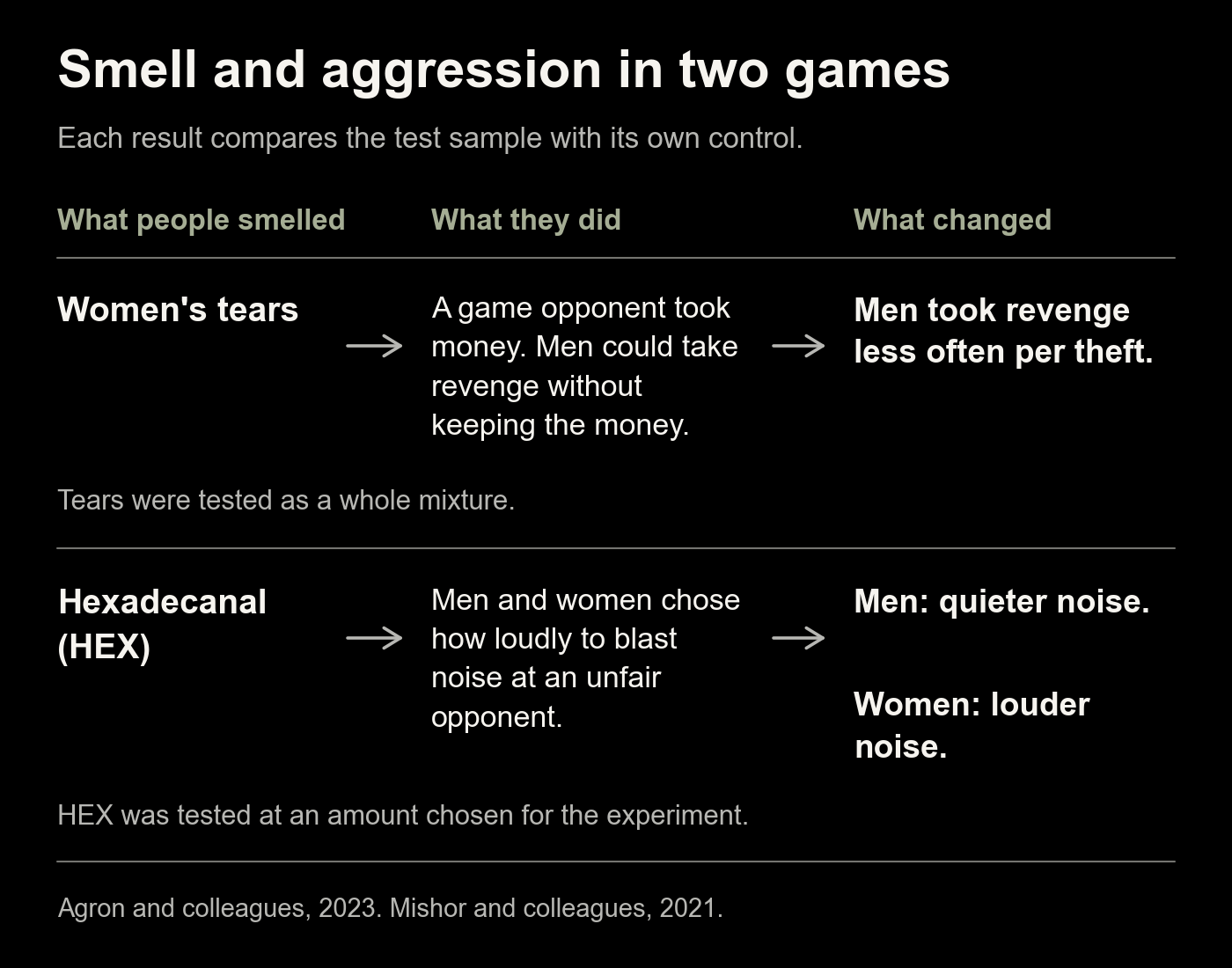
Two studies using different samples and tasks. The tear experiment counted revenge responses for each theft. The HEX experiment measured the noise volume chosen by 127 people. The arrows show the order of events. The results describe the direction of change, without comparing its size across the studies.10, 9
10. Perfumes, products and patents
People can still recognize someone’s body odor after perfume has been added. Fragrance experiments have tested both this recognition and how pleasant the combined smell is. A pheromone claim would need a test of the specific response the chemical is said to cause.150
Deodorants and antiperspirants can change the mix of armpit microbes. A study that counted these microbes did not measure attraction, so it cannot tell us which product makes someone smell more attractive.173
10.1. Studies of pheromone products
Two small trials asked people to keep diaries of their sex lives. In Cutler and colleagues’ 1998 study, 38 men finished a trial using aftershave with either a test additive or a comparison additive under coded labels. Men using the test additive more often reported an increase in days when they had sex or slept beside a partner. Several other diary measures showed no clear difference.174
McCoy and Pitino studied 36 women who finished a similar trial using a perfume additive or a comparison additive. Some diary measures involving a partner, including sex, favored the test product. The number of approaches and casual dates did not clearly differ.175
These trials reported benefits for some parts of the participants’ sex lives. Confidence is limited by the small groups, people leaving the trials, differences between groups at the start, and the many diary measures tested. The suppliers were also involved. Each study used a different formula, and neither published its full chemical recipe. Their results apply to those products and cannot identify which ingredient produced the changes.174, 175
10.2. Pheromone patents
Patents document ingredients, experiments and proposed uses. Their value depends on what the inventors actually tested. Several examples show the range:176, 177
US5272134A, the Berliner fragrance patent, reports electrical responses from electrodes inside the nose. It did not test the attractiveness of someone wearing the fragrance.176
WO2025013888A1 covers fragrance mixtures linked to the menstrual cycle. It belongs to the same research program as the geranylacetone and fatty-acid paper in section 7.1. The patent and paper are not independent confirmations.177, 52
WO2009003935A1, Andrea Büttner’s application, describes repeated vaginal sampling in three women. It identifies acids, sulfur compounds, vanillin and fruity or floral odor chemicals. Proposed uses concern sperm movement and sexual stimulation, but the worked examples test collection and chemical identity.178
US20090117163A1, Alexandra Fede’s application, proposes scent-releasing capsules for clothes or jewelry. It lists steroids and copulins, without a controlled trial of the claimed attention, mood or attraction effects. One ingredient is called androstenediol while its chemical name describes androstenol.179
EP3462875A1 tests hormones as rodent attractants. Progesterone alone and a progesterone–estradiol mixture reportedly increased male mouse captures. Estradiol alone did not. Testosterone drew female mice toward a treated chamber in a lab test. These are mouse results.180
US8679507B2, Moshe Shifrine’s Testosterone olfaction, reports increased saliva testosterone after ten men applied truffle extract above the lip for several nights. With no control group, possible skin absorption and other extract ingredients, it does not isolate an effect of smelling testosterone.181
One invention may appear under several patent numbers and languages. Japanese, international and Spanish filings can describe the same work.176, 182, 183, 184
Japanese reviews also discuss plant fragrances with proposed pheromone-like effects. Their effects on people are a separate topic from chemicals released by humans.185, 186
10.3. What people report after using hormones
Personal reports can describe changes that formal experiments have not yet tested. In a 2026 Bioenergetic Forum discussion, one man described more pleasant armpit odor and more attention from women after using several hormone products. His account included testosterone and related steroids, along with other supplements and changes in his routine. Several things changed together. The post records his experience, but it does not isolate which change affected his smell or the way people responded to him.187
Other reports focus on odor itself. In a Reddit discussion about progesterone, the original poster and two people replying described stronger body odor after starting it. One said the change went away after stopping. Another reported that it settled after a doctor added a different medicine. These accounts describe changes during hormone treatment. They contain no measurement of the chemicals leaving the skin or test of attraction in someone else.188
These reports give researchers concrete observations to investigate: changes in smell, changes in the chemicals leaving the skin and changes in other people’s responses. The user’s own mood and behavior may change too. A calmer manner or more eye contact could affect an interaction without a change in scent. These accounts are not instructions to use hormones.187, 188
11. What research has found so far
Human scent can affect how people experience each other. The examples include recognizing someone familiar, responding to threat, judging a face and a newborn’s movements toward feeding. Those responses have different purposes, even when they all begin at the nose.1, 3, 147, 2, 159
The chemistry is equally varied. Skin cells and microbes make and change odor chemicals. Air can change them again. The person smelling them brings their own receptors, hormone state and experience. Together, these findings explain why measuring one hormone gives only part of the information needed to understand someone’s scent and its effects.5, 6, 54, 42, 7, 77
For attraction, the response matters as much as the chemical’s name. A higher rating, a change in arousal and a decision to meet again are separate outcomes. The speed-dating experiment measured two of them and found different results. Keeping those distinctions makes it possible to say clearly what a chemical changed.72, 8
People already use smell to recognize, approach and respond to one another. Research is giving those everyday experiences chemical detail: what the body releases, how another person detects it and which part of the encounter changes.1, 7, 147, 2
12. Glossary
Semiochemical: A chemical that affects how living things interact. Pheromones are one kind.13
Kairomone: A chemical that helps a different species, as when a predator uses another animal’s smell to find it.13
Releaser / primer: A releaser effect is a fairly quick change in behavior. A primer effect is a slower change in the body, such as development. These names describe the response in a particular setting.13
AND: Short for androstadienone. A steroid tested for effects on hormones, smell and social behavior. Section 6.1.36, 8
ADL: Short for androstadienol. A steroid that can be changed into other 16-androstenes. Section 6.3.35
Androsterone / androstenone: Two different steroids with similar names. Their chemical drawings are in section 4.2.36
Androstenols: Steroids whose alpha and beta forms have the same parts arranged differently. Section 6.2.36
EST: Short for estratetraenol. A chemical tested as a possible human pheromone. Section 6.4.103
Copulins: A name for mixtures of short-chain acids found in vaginal fluid. Section 6.6.106
HEX: Short for hexadecanal. A different chemical from hexadecanoic acid, also called palmitic acid. Section 9.6.9, 165
HLA / MHC: A group of genes that helps the immune system recognize what belongs in the body. MHC is the general name, and HLA refers to the human form. Section 8.1.132
LH: Luteinizing hormone. It helps control reproduction and is released in repeated bursts. Section 7.2.120
OR7D4: A smell receptor that reacts to androstenone and AND. Section 5.1.7
VNO: Vomeronasal organ. A small structure inside the nose that detects chemicals from other animals in many species. Its role in adult humans remains uncertain. Section 5.2.1
Headspace: The air around a source of smell. Collecting it gives a different sample from touching a pad to the skin. Section 4.5.53
Precursor / enzyme: A precursor is a starting material for another chemical. An enzyme is a protein that speeds up a chemical reaction. Section 4.1.5, 6
Specific anosmia: Difficulty smelling one particular chemical while being able to smell other things. Section 5.1.66
Between-person / within-person: A comparison of different people, or repeated measurements of the same person. Section 7.1.111, 115
Significant / null finding: A result that passes a chosen statistical test, or one that does not provide enough evidence for the expected effect. These terms alone do not tell us how large or useful an effect is. Section 2.20
References
Tristram D. Wyatt (2014). On the scent of human attraction: human pheromones?. DOI: 10.1017/CBO9781139030748.015. Chapter 13, pp. 275–303. Recognition pp. 278–281, production pp. 284–291, receptors pp. 291–295 and candidates pp. 295–302.
Doucet S, Soussignan R, Sagot P, Schaal B (2009). The secretion of areolar (Montgomery’s) glands from lactating women elicits selective, unconditional responses in neonates. DOI: 10.1371/journal.pone.0007579. PMID: 19851461. Results pp. 2–3, Figure 1 and Methods pp. 7–9.
de Groot JHB, Smeets MAM (2017). Human Fear Chemosignaling: Evidence from a Meta-Analysis. DOI: 10.1093/chemse/bjx049. PMID: 28981822. Methods, overall synthesis, heterogeneity and limitations.
Gower DB, Holland KT, Mallet AI, Rennie PJ, Watkins WJ (1994). Comparison of 16-androstene steroid concentrations in sterile apocrine sweat and axillary secretions: interconversions of 16-androstenes by the axillary microflora--a mechanism for axillary odour production in man?. DOI: 10.1016/0960-0760(94)90082-5. PMID: 8142319. Methods and Results, induced apocrine secretions, skin extracts and bacterial transformations.
Minhas GS, Bawdon D, Herman R, Rudden M, Stone AP, James AG, Thomas GH, Newstead S (2018). Structural basis of malodour precursor transport in the human axilla. DOI: 10.7554/elife.34995. PMID: 29966586. Results, precursor transport and structural analyses.
Rudden M, Herman R, Rose M, Bawdon D, Cox DS, Dodson E, Holden MTG, Wilkinson AJ, James AG, Thomas GH (2020). The molecular basis of thioalcohol production in human body odour. DOI: 10.1038/s41598-020-68860-z. PMID: 32719469. Results, Figures 1–3 and 6, and Discussion.
Keller A, Zhuang H, Chi Q, Vosshall LB, Matsunami H (2007). Genetic variation in a human odorant receptor alters odour perception. DOI: 10.1038/nature06162. PMID: 17873857. pp. 468–472, Figures 1–4 and online Methods.
Wyart C, Webster WW, Chen JH, Wilson SR, McClary A, Khan RM, Sobel N (2007). Smelling a single component of male sweat alters levels of cortisol in women. DOI: 10.1523/jneurosci.4430-06.2007. PMID: 17287500. Methods, cortisol time course and second-sample experiment.
Mishor E, Amir D, Weiss T, Honigstein D, Weissbrod A, Livne E, Gorodisky L, Karagach S, Ravia A, Snitz K, Karawani D, Zirler R, Weissgross R, Soroka T, Endevelt-Shapira Y, Agron S, Rozenkrantz L, Reshef N, Furman-Haran E, Breer H, Strotmann J, Uebi T, Ozaki M, Sobel N (2021). Sniffing the human body volatile hexadecanal blocks aggression in men but triggers aggression in women. DOI: 10.1126/sciadv.abg1530. PMID: 34797713. Results, aggression experiments. Discussion, natural exposure and ecological limits.
Agron S, de March CA, Weissgross R, Mishor E, Gorodisky L, Weiss T, Furman-Haran E, Matsunami H, Sobel N (2023). A chemical signal in human female tears lowers aggression in males. DOI: 10.1371/journal.pbio.3002442. PMID: 38127837. Results, aggression task, receptor assays and imaging. Discussion, ecological and receptor-causation limits.
Wisman A, Shrira I (2020). Sexual Chemosignals: Evidence that Men Process Olfactory Signals of Women’s Sexual Arousal. DOI: 10.1007/s10508-019-01588-8. PMID: 32026223. Experiments 1–3 Methods and Results, Table 1, General Discussion and footnotes.
Karlson P, Lüscher M (1959). ‘Pheromones’: a new term for a class of biologically active substances. DOI: 10.1038/183055a0. PMID: 13622694. Nature 183, pp. 55–56, definition and proposed classification.
Tristram D. Wyatt (2014). Pheromones and Animal Behavior: Chemical Signals and Signatures. DOI: 10.1017/CBO9781139030748. ISBN: 9780521112901. Second edition. Chapter 1, pp. 1–2, 6–7 and 13–16. Chapter 2, pp. 49–56. Chapter 13, pp. 275–303.
Nouvian M, Hotier L, Claudianos C, Giurfa M, Reinhard J (2015). Appetitive floral odours prevent aggression in honeybees. DOI: 10.1038/ncomms10247. PMID: 26694599. Results, Table 1, Methods and Discussion.
Roberts SA, Simpson DM, Armstrong SD, Davidson AJ, Robertson DH, McLean L, Beynon RJ, Hurst JL (2010). Darcin: a male pheromone that stimulates female memory and sexual attraction to an individual male’s odour. DOI: 10.1186/1741-7007-8-75. PMID: 20525243. Results, recombinant-protein experiments and Figures 7 and 10. Methods pp. 17–20.
Schaal B, Coureaud G, Langlois D, Giniès C, Sémon E, Perrier G (2003). Chemical and behavioural characterization of the rabbit mammary pheromone. DOI: 10.1038/nature01739. PMID: 12840760. Nature 424, pp. 68–72, especially Figures 2–4 and removal/add-back experiments.
Choe DH, Villafuerte DB, Tsutsui ND (2012). Trail pheromone of the Argentine ant, Linepithema humile (Mayr) (Hymenoptera: Formicidae). DOI: 10.1371/journal.pone.0045016. PMID: 23028739. Results, Table 1, Figures 3–4 and Methods.
Kenji Mori (2010). Chemical Synthesis of Hormones, Pheromones and Other Bioregulators. DOI: 10.1002/9780470669228. ISBN: 9780470697245. Chapter 4, §§4.1–4.3, pp. 107–111.
Sakurai T, Mitsuno H, Haupt SS, Uchino K, Yokohari F, Nishioka T, Kobayashi I, Sezutsu H, Tamura T, Kanzaki R (2011). A single sex pheromone receptor determines chemical response specificity of sexual behavior in the silkmoth Bombyx mori. DOI: 10.1371/journal.pgen.1002115. PMID: 21738481. Results pp. 2–7, Figure 3 and Table 1. Methods pp. 7–8.
Wyatt TD (2020). Reproducible research into human chemical communication by cues and pheromones: learning from psychology’s renaissance. DOI: 10.1098/rstb.2019.0262. PMID: 32306877. §§5–8, reproducibility, preregistration and future study design.
Idan Frumin, Noam Sobel (2013). An Assay for Human Chemosignals. DOI: 10.1007/978-1-62703-619-1_27. ISBN: 9781627036184. Chapter 27, pp. 373–394. Design pp. 382–388 and methodological notes pp. 388–392.
Fumiyo Toyoda and colleagues. The abdominal gland of the male red-bellied newt generates steroids that act synergistically with sodefrin as a courtship pheromone (2026). Physiology & Behavior 312, 115347. Methods 2.7–2.10, Results 3.1–3.4, Figures 1–3 and Table 1. PMID: 41990986. Source.
Fumiyo Toyoda. 有尾両生類における性フェロモンの作用機構の解明 [The Action of the Sex Pheromones in Urodele] (2013-05-31). KAKENHI project 22570075, final research report. Japanese original, English abstract and sections 3–4. Source.
Loos HM, Schaal B, Pause BM, Smeets MAM, Ferdenzi C, Roberts SC, de Groot J, Lübke KT, Croy I, Freiherr J, Bensafi M, Hummel T, Havlíček J (2025). Past, Present, and Future of Human Chemical Communication Research. DOI: 10.1177/17456916231188147. PMID: 37669015. Terminology, pp. 21–22, social recognition, pp. 24–25, and research roadmap, pp. 33–34. Online 2023, final issue 2025.
Natalia Drabińska, Cheryl Flynn, Norman Ratcliffe, Ilaria Belluomo, Antonis Myridakis, Oliver Gould, Matteo Fois, Amy Smart, Terry Devine, Ben de Lacy Costello (2021). A literature survey of all volatiles from healthy human breath and bodily fluids: the human volatilome. DOI: 10.1088/1752-7163/abf1d0. PMID: 33761469. Review abstract, Methods and compartment summaries.
Anuja Mitra, Sunyoung Choi, Piers R Boshier, Alexandra Razumovskaya-Hough, Ilaria Belluomo, Patrik Spanel, George B Hanna (2022). The Human Skin Volatolome: A Systematic Review of Untargeted Mass Spectrometry Analysis. DOI: 10.3390/metabo12090824. PMID: 36144228. Methods, Results and supplementary Table S3.
Diana Owsienko, Lisa Goppelt, Katharina Hierl, Laura Schäfer, Ilona Croy and Helene M. Loos (2024). Body odor samples from infants and post-pubertal children differ in their volatile profiles. Communications Chemistry 7, 53. Results, Table 1 and Methods, “BO donors.” PMID 38514840. Original source.
Reyme Herman, Bethan Kinniment-Williams, Michelle Rudden, Alexander Gordon James, Anthony J Wilkinson, Barry Murphy, Gavin H Thomas (2024). Identification of a staphylococcal dipeptidase involved in the production of human body odor. DOI: 10.1016/j.jbc.2024.107928. PMID: 39454956. Results, ShPepV enzyme assays and pathway figures.
Martin A, Saathoff M, Kuhn F, Max H, Terstegen L, Natsch A (2010). A functional ABCC11 allele is essential in the biochemical formation of human axillary odor. DOI: 10.1038/jid.2009.254. PMID: 19710689. pp. 529–540, donor Table 1 and precursor tables.
Harker M, Carvell AM, Marti VP, Riazanskaia S, Kelso H, Taylor D, Grimshaw S, Arnold DS, Zillmer R, Shaw J, Kirk JM, Alcasid ZM, Gonzales-Tanon S, Chan GP, Rosing EA, Smith AM (2014). Functional characterisation of a SNP in the ABCC11 allele - effects on axillary skin metabolism, odour generation and associated behaviours. DOI: 10.1016/j.jdermsci.2013.08.016. PMID: 24076068. pp. 23–30, Methods §§2.1–2.8, Tables 1–2 and Discussion.
Tim Baumann, Sophia Bergmann, Thomas Schmidt-Rose, Heiner Max, Annette Martin, Bernd Enthaler, Lara Terstegen, Dorothea Schweiger, Hubert Kalbacher, Horst Wenck, Gabriele Jedlitschky, Zorica Jovanovic (2014). Glutathione-conjugated sulfanylalkanols are substrates for ABCC11 and γ-glutamyl transferase 1: a potential new pathway for the formation of odorant precursors in the apocrine sweat gland. DOI: 10.1111/exd.12354. PMID: 24533866. Results, ABCC11 transport assays, GGT1 conversion and gland staining.
Andreas Natsch, Roger Emter (2020). The specific biochemistry of human axilla odour formation viewed in an evolutionary context. DOI: 10.1098/rstb.2019.0269. PMID: 32306870. Sections 1–6 and N-AGA structural analysis.
Camille Ferdenzi, Géraldine Coppin, Christophe Bousquet, Sylvain Delplanque (2025). The perception of gender in two allegedly sex-specific body odor compounds MSH and HMHA. DOI: 10.1038/s41598-025-26457-4. PMID: 41309809. Scientific Reports 15, 42447. Methods and Results, participant selection and odor ratings.
Kwan TK, Kraevskaya MA, Makin HL, Trafford DJ, Gower DB (1997). Use of gas chromatographic-mass spectrometric techniques in studies of androst-16-ene and androgen biosynthesis in human testis; cytosolic specific binding of 5alpha-androst-16-en-3-one. DOI: 10.1016/s0960-0760(96)00162-8. PMID: 9182868. pp. 139–145, Table 3 and Figure 3.
Isabelle Dufort, Penny Soucy, Lucille Lacoste and Van Luu-The (2001). Comparative biosynthetic pathway of androstenol and androgens. DOI: 10.1016/s0960-0760(01)00057-7. PMID: 11457660. Methods and Results, expressed human enzymes and sequential steroid conversions.
National Center for Biotechnology Information. PubChem compound registry. Androsterone, androstenone, 3α-androstenol, 3β-androstenol. Compound identity and synonym records, plus 2D structures for androsterone and androstenone. Accessed 11 and 14 September 2026.
Weusten JJ, Smals AG, Hofman JA, Kloppenborg PW, Benraad TJ (1987). The sex pheromone precursor androsta-5,16-dien-3 beta-ol is a major early metabolite in in vitro pregnenolone metabolism in human testicular homogenates. DOI: 10.1210/jcem-65-4-753. PMID: 3654919. pp. 753–756, especially Figure 3.
Soucy P, Lacoste L, Luu-The V (2003). Assessment of porcine and human 16-ene-synthase, a third activity of P450c17, in the formation of an androstenol precursor. Role of recombinant cytochrome b5 and P450 reductase. DOI: 10.1046/j.1432-1033.2003.03508.x. PMID: 12631293. pp. 1350–1355, Figures 2–6.
John N. Labows, George Preti, Erhard Hoelzle, James Leyden and Albert Kligman (1979). Steroid analysis of human apocrine secretion. Steroids 34, 249–258. Collection methods and results on pp. 251–257. Original source.
Gower DB, Mallet AI, Watkins WJ, Wallace LM, Calame JP (1997). Capillary gas chromatography with chemical ionization negative ion mass spectrometry in the identification of odorous steroids formed in metabolic studies of the sulphates of androsterone, DHA and 5alpha-androst-16-en-3beta-ol with human axillary bacterial isolates. DOI: 10.1016/s0960-0760(97)00075-7. PMID: 9449209. pp. 81–89, Methods, Table 2 and Figures 2–4.
Heidi M. Laderoute (2015). The Metabolism of Androstenone and Other Steroid Hormone Conjugates in Relation to Boar Taint. Chapter 4, printed pp. 59–82, especially methods pp. 61–63 and Table 4.3.
Zouboulis CC, Chen WC, Thornton MJ, Qin K, Rosenfield R (2007). Sexual hormones in human skin. DOI: 10.1055/s-2007-961807. PMID: 17326004. pp. 85–87, skin steroid metabolism and cell-specific enzyme activity.
B. W. L. Brooksbank (1970). Labelling of steroids in axillary sweat after administration of 3H-delta-5-pregnenolone and 14C-progesterone to a healthy man. DOI: 10.1007/BF02114166. PMID: 4249154. Experientia 26, 1012–1014. Collection methods and product table, p. 1013.
Cameron C. Muir and colleagues. Enzyme Immunoassay of Testosterone, 17β-Estradiol, and Progesterone in Perspiration and Urine of Preadolescents and Young Adults: Exceptional Levels in Men’s Axillary Perspiration (2008). Hormone and Metabolic Research 40, 819–826. Methods and assay validation, Results of studies 1–2, Table 2 and Discussion. Source.
Brittney Elliott, Cameron Muir and Denys deCatanzaro. Sources of variance within and among young men in concentrations of 17β-estradiol and testosterone in axillary perspiration (2017). Physiology & Behavior 173, 23–29. Methods 2.1–2.5, Results 3.2–3.4, Tables 1, 3–4 and Discussion. Source.
Alvi SN, Abuhdeeb K, Hammami MM (2022). Sweat Cortisol and Cortisone Determination in Healthy Adults: UHPLC-MS/MS Assay Validation and Clinical Application. DOI: 10.1155/2022/3133640. PMID: 36483476. Methods and Results, assay validation and 50 volunteer sweat samples.
J. Ray Runyon, Min Jia, Michael R. Goldstein, Perry Skeath, Leif Abrell, Jon Chorover, Esther M. Sternberg (2019). Dynamic Behavior of Cortisol and Cortisol Metabolites in Human Eccrine Sweat. DOI: 10.36001/ijphm.2019.v10i3.2707. pp. 2–4, methods; pp. 7–8, results and conclusion.
Syed Imran Ali Shah and colleagues. Gonadal suppression alters axillary steroid secretions in men, but does that affect olfactory social signaling? (2021). Journal of Men’s Health 17(3), 69–76. Methods 2.1–2.3, Results 3.1–3.3 and Tables 1–2. Source.
Havlíček J, Lenochová P (2006). The effect of meat consumption on body odor attractiveness. DOI: 10.1093/chemse/bjl017. PMID: 16891352. pp. 747–752, Methods, Results and Discussion.
Fialová J, Roberts SC, Havlíček J (2016). Consumption of garlic positively affects hedonic perception of axillary body odour. DOI: 10.1016/j.appet.2015.11.001. PMID: 26551789. pp. 9–13, Methods, Results, Table 1 and Discussion.
Zetzsche M, Weiß BM, Kücklich M, Stern J, Birkemeyer C, Widdig A, Penke L (2024). Combined perceptual and chemical analyses show no compelling evidence for ovulatory cycle shifts in women’s axillary odour. DOI: 10.1098/rspb.2023.2712. PMID: 39043247. Methods, Results, chemical-profile and perceptual models.
Ohgi N, Shirasu M, Ogura Y, Hirasawa Y, Okamoto M, Kawamura R, Takikawa H, Touhara K (2025). Human ovulatory phase-increasing odors cause positive emotions and stress-suppressive effects in males. DOI: 10.1016/j.isci.2025.113087. PMID: 40948555. Methods, chemical screening, blend evaluations and competing interests.
Brémond Bostoen V, Richard Ortegón S, Barthès N, Buatois B, Nicolè F, Steyer D, Dormont L, Ferdenzi C (2025). ABOV: A Novel System of Direct Headspace Skin Sampling to Study Human Body Odor. DOI: 10.1007/s10886-025-01581-7. PMID: 40056297. Methods and Results, above-skin sampling, donor profiles and cross-center comparison.
Yuekun Qu, Ziwei Zou, Charles J Weschler, Yingjun Liu, Xudong Yang (2025). Influence of Temperature, Humidity, Personal Hygiene, and Clothing on the Ozonolysis of Skin Oil at the Skin’s Surface: Self Regulation. DOI: 10.1021/acsenvironau.5c00073. PMID: 40979464. Methods, Results on clothing and hygiene, Discussion.
Jessica L. Zung and Carolyn S. McBride (2025). Sebaceous origins of human odor. Current Biology 35, R303–R313. Sections on fatty acid production and oxidation, Figures 2–3. Scientific review. Original source.
Lan Ge, Joel S. Gordon, Charleen Hsuan, Kurt Stenn and Stephen M. Prouty (2003). Identification of the delta-6 desaturase of human sebaceous glands: Expression and enzyme activity. Journal of Investigative Dermatology 120, 707–714. Results and Figures 1, 4–6. Original source.
Christos C. Zouboulis and colleagues (2002). Corticotropin-releasing hormone: An autocrine hormone that promotes lipogenesis in human sebocytes. Proceedings of the National Academy of Sciences 99, 7148–7153. Methods, Results and Figures 3–5. PMID 12011471. Original source.
Terry M. Smith, Zhaoyuan Cong, Kathryn L. Gilliland, Gary A. Clawson and Diane M. Thiboutot (2006). Insulin-like growth factor-1 induces lipid production in human SEB-1 sebocytes via sterol response element-binding protein-1. Journal of Investigative Dermatology 126, 1226–1232. Results, Figures 2–5 and lipogenesis methods. Original source.
S. K. Goolamali, D. Evered and Sam Shuster (1976). Thyroid disease and sebaceous function. British Medical Journal 1, 432–433. Patients and methods, Results and Figures 1–3. Original source.
Takeshi Hara, Hiroshi Matsui, Hironori Shimizu (2014). Suppression of microbial metabolic pathways inhibits the generation of the human body odor component diacetyl by Staphylococcus spp. DOI: 10.1371/journal.pone.0111833. PMID: 25390046. Culture methods, Figures 1 and 4–6, Results and Discussion.
Takeshi Hara, Akito Sakanaka, Richard J Lamont, Atsuo Amano, Masae Kuboniwa (2024). Interspecies metabolite transfer fuels the methionine metabolism of Fusobacterium nucleatum to stimulate volatile methyl mercaptan production. DOI: 10.1128/msystems.00764-23. PMID: 38289043. Results on co-culture, ornithine, arcD deletion and methionine metabolism.
Elliot M Lee, Sujatha Srinivasan, Samuel O Purvine, Tina L Fiedler, Owen P Leiser, Sean C Proll, Samuel S Minot, Danijel Djukovic, Daniel Raftery, Christine Johnston, David N Fredricks, Brooke L Deatherage Kaiser (2025). Syntrophic bacterial and host–microbe interactions in bacterial vaginosis. DOI: 10.1093/ismejo/wraf055. PMID: 40576334. Metaproteomics methods, Results and bacterial co-culture experiments.
Wagenstaller M, Buettner A (2013). Quantitative determination of common urinary odorants and their glucuronide conjugates in human urine. DOI: 10.3390/metabo3030637. PMID: 24958143. Sections 2.1–2.2, 3 and 4.1–4.9.
Rohto Pharmaceutical (2023). An odorless lactone precursor changes into lactone on the skin. Original Japanese research report, 8 November 2023. Results 1–2, Figures 1–2 and ingredient notes. Corporate research report. Original source.
Marie-Annick Persuy, Guenhaël Sanz, Anne Tromelin, Thierry Thomas-Danguin, Jean-François Gibrat, Edith Pajot-Augy (2015). Mammalian Olfactory Receptors: Molecular Mechanisms of Odorant Detection, 3D-Modeling, and Structure–Activity Relationships. DOI: 10.1016/bs.pmbts.2014.11.001. §§1.2–1.3, printed pp. 5–9: receptor expression, combinatorial detection and nerve transmission to the olfactory bulb.
Gillmeister A, Nagai MH, Margot C, Meesa P, Matsunami H, Hummel T (2025). Olfactory training in specific anosmia to androstenone and its association with genetic variations of OR7D4. DOI: 10.1016/j.ibneur.2025.06.017. PMID: 40687083. Methods §§2.1–2.5, Results §§3.1–3.3, Figures 2–4 and Discussion §4.1.
Chulwon Choi, Hyeonsung Byeon, Juho Lee, Hong Geun Lee, Chaok Seok, Hee-Jung Choi (2026). Structural basis of the sweat odorant HMHA recognition by the human odorant receptor OR52E8. DOI: 10.1038/s42003-026-10317-6. PMID: 42162228. Results, native-receptor functional assays and engineered-receptor structure.
Camille Ferdenzi, Harilanto Razafindrazaka, Nicolas Baldovini, Daphnée Poupon, Denis Pierron, Moustafa Bensafi (2019). Influence of gender and culture on the perception of acidic compounds of human body odor. DOI: 10.1016/j.physbeh.2019.112561. PMID: 31178171. Methods 2.1–2.2 and Results 3.1–3.2.
Monti-Bloch L, Diaz-Sanchez V, Jennings-White C, Berliner DL (1998). Modulation of serum testosterone and autonomic function through stimulation of the male human vomeronasal organ (VNO) with pregna-4,20-diene-3,6-dione. DOI: 10.1016/s0960-0760(98)00025-9. PMID: 9699878. pp. 237–242, Methods, endocrine crossover experiment and Discussion.
Frasnelli J, Lundström JN, Boyle JA, Katsarkas A, Jones-Gotman M (2011). The vomeronasal organ is not involved in the perception of endogenous odors. DOI: 10.1002/hbm.21035. PMID: 20578170. Vomeronasal occlusion and sham experiments, Results and Discussion.
S. Henningsson and colleagues (2017). A missense polymorphism in the putative pheromone receptor gene VN1R1 is associated with sociosexual behavior. Translational Psychiatry 7, e1102. Results, Tables 1–3 and limitations on pp. 3–5. Original source.
Saxton TK, Lyndon A, Little AC, Roberts SC (2008). Evidence that androstadienone, a putative human chemosignal, modulates women’s attributions of men’s attractiveness. DOI: 10.1016/j.yhbeh.2008.06.001. PMID: 18601928. pp. 598–600, Methods, Results and Figures 1–3.
Hare RM, Schlatter S, Rhodes G, Simmons LW (2017). Putative sex-specific human pheromones do not affect gender perception, attractiveness ratings or unfaithfulness judgements of opposite sex faces. DOI: 10.1098/rsos.160831. PMID: 28405372. Methods §§2.1–2.3, Results and Discussion.
Chung KC, Peisen F, Kogler L, Radke S, Turetsky B, Freiherr J, Derntl B (2016). The Influence of Menstrual Cycle and Androstadienone on Female Stress Reactions: An fMRI Study. DOI: 10.3389/fnhum.2016.00044. PMID: 26909031. Methods, Results and cortisol analyses.
Zhou W, Yang X, Chen K, Cai P, He S, Jiang Y (2014). Chemosensory communication of gender through two human steroids in a sexually dimorphic manner. DOI: 10.1016/j.cub.2014.03.035. PMID: 24794295. Methods, point-light walker experiments and Discussion.
Alison S. Fleming, Meir Steiner and Carl Corter (1997). Cortisol, Hedonics, and Maternal Responsiveness in Human Mothers. Hormones and Behavior 32, 85–98. Odor tests, Table 1 and results on pp. 89–92. PMID 9367716. Original source.
Ayline Maier, Dirk Scheele and colleagues. Oxytocin reduces a chemosensory-induced stress bias in social perception (2019). Neuropsychopharmacology 44, 281–288. Published online 2018. Methods, Results and Figures 2–5. PMID: 29703998. Source.
Kepu Chen, Yuting Ye, Nikolaus F. Troje and Wen Zhou. Oxytocin modulates human chemosensory decoding of sex in a dose-dependent manner (2021). eLife 10, e59376. Experiments 1–5, especially Experiments 3–5 and Figures 4–5. Source.
R. Rodriguez-Raecke, Y. F. Brünner and colleagues. Odor Sensitivity After Intranasal Insulin Application Is Modulated by Gender (2018). Frontiers in Endocrinology 9, 580. Participants, olfactory tests, Results and Figure 2. Source.
S. Edwin Thanarajah, V. Hoffstall and colleagues. The role of insulin sensitivity and intranasally applied insulin on olfactory perception (2019). Scientific Reports 9. Research Design and Methods, Results and Figures 1–4. 36 recruited, 33 analyzed. Source.
Ninthujah Kanageswaran and colleagues. Modulatory Effects of Sex Steroids Progesterone and Estradiol on Odorant Evoked Responses in Olfactory Receptor Neurons (2016). PLOS ONE 11, e0159640. Methods, Figure 6 and Discussion. PMID: 27494699. Source.
Adithya Mohandass and colleagues. TRPM8 as the rapid testosterone signaling receptor: Implications in the regulation of dimorphic sexual and social behaviors (2020). The FASEB Journal 34(8), 10887–10906. Methods 2.1, Results 3.3, 3.5–3.6 and Figures 3, 5–6. PMID: 32609392. Source.
Luis Monti and colleagues. Effect of fasedienol (PH94B) pherine nasal spray and steroidal hormones on electrogram responses and autonomic nervous system activity in healthy adult volunteers (2024). Human Psychopharmacology 39(2), e2892. Methods, Results and sponsor disclosures. PMID: 38193849. Source.
Wyatt TD (2015). The search for human pheromones: the lost decades and the necessity of returning to first principles. DOI: 10.1098/rspb.2014.2994. PMID: 25740891. §§2, 4 and 6, criteria, steroid candidates and discovery methods.
Robin Tan (2017). The Effect of Androstenone as a Mating Prime on Drinking and Approach Behavior. PhD dissertation, University of South Florida. Methods, pp. 12–22. Results, pp. 24–29. Table 2, p. 53. The main text and Table 2 give different t-values for beer consumption, both with a reported p-value of 0.03.
Alan A. Beaton, Lowri Jones, David Benton, Gareth Richards (2022). Judgements of attractiveness of the opposite sex and nostril differences in self-rated mood: The effects of androstenol. DOI: 10.1016/j.biopsycho.2021.108237. PMID: 34864067. Author manuscript PDF pp. 8–15, Methods and Results, Table 1.
R. E. Maiworm and W. U. Langthaler. Influence of Androstenol and Androsterone on the Evalulation of Men of Varying Attractiveness Levels (1992). Chemical Signals in Vertebrates 6, pp. 575–579. Complete chapter, Methods, Table 1 and Discussion. Source.
Wu Y, Wei R, Ou J, Shen B, Ye Y (2022). Estratetraenol increases preference for large sexual reward but not impulsivity among heterosexual males. DOI: 10.1016/j.yhbeh.2022.105266. PMID: 36152381. pp. 2–4, Methods §§2.1–2.6 and Results §§3.1–3.3, Figure 2.
Williams M, Jacobson A (2016). Effect of Copulins on Rating of Female Attractiveness, Mate-Guarding, and Self-Perceived Sexual Desirability. DOI: 10.1177/1474704916643328. Methods and Results, face ratings, self-perceived desirability and mate guarding.
Megan N. Williams; Coren Apicella (2017). Synthetic Copulin Does Not Affect Men’s Sexual Behavior. DOI: 10.1007/s40750-017-0083-y. Methods, Results and Discussion, four-condition experiment.
Sun Yuefen (孙月芬), Hu Peicheng (胡佩诚) (2004). 人类体味的异性偏好现象初探 [A preliminary study of opposite-sex preferences for human body odor]. Chinese Journal of Human Sexuality 13(10), printed pp. 8–9. Methods and results tables. Title translated from Chinese.
Lu J, Ye Y, Wu Y (2024). Little evidence that androstadienone affects social distance-dependent prosocial behaviour: a pre-registered study. DOI: 10.1098/rsos.240004. PMID: 39076351. Methods and Results, social-discounting experiment.
Lundström JN, Olsson MJ (2005). Subthreshold amounts of social odorant affect mood, but not behavior, in heterosexual women when tested by a male, but not a female, experimenter. DOI: 10.1016/j.biopsycho.2005.01.008. PMID: 16242537. pp. 198–203, Methods §§1.1–1.7, Results §§2.1–2.3 and Discussion.
Wu Y, Wei R, Nan Y, Hu Y, Ye Y (2023). Androstadienone modulates human aggression in a sex-dependent manner. DOI: 10.1093/scan/nsad006. PMID: 36790105. Participants, olfactory stimuli, aggression tasks, Results Figure 2 and Discussion.
Hummel T, Gollisch R, Wildt G, Kobal G (1991). Changes in olfactory perception during the menstrual cycle. DOI: 10.1007/bf01958823. PMID: 2065768. Methods and Results, cycle-phase pleasantness and detection thresholds.
Lübke KT, Pause BM (2014). Sex-hormone dependent perception of androstenone suggests its involvement in communicating competition and aggression. DOI: 10.1016/j.physbeh.2013.10.016. PMID: 24184511. pp. 136–141, Methods, Results and Discussion. Read with the separately listed corrigendum.
Katrin T. Lübke; Bettina M. Pause (2014). Corrigendum to “Sex-hormone dependent perception of androstenone suggests its involvement in communicating competition and aggression” [Physiol Behav 123 (2014) 136-141]. DOI: 10.1016/j.physbeh.2014.02.001. pp. 52–53, corrected abstract statement and figure labels.
Cowley JJ, Brooksbank BW (1991). Human exposure to putative pheromones and changes in aspects of social behaviour. DOI: 10.1016/0960-0760(91)90264-6. PMID: 1892794. Methods and Tables 2a–2b, necklace exposure and recalled verbal exchanges.
Gustavson AR, Dawson ME, Bonett DG (1987). Androstenol, a putative human pheromone, affects human (Homo sapiens) male choice performance. DOI: 10.1037/0735-7036.101.2.210. PMID: 3608426. pp. 210–212, Method, Table 1, Results and Discussion.
Dorota Zolkowska and colleagues. Anticonvulsant potencies of the enantiomers of the neurosteroids androsterone and etiocholanolone exceed those of the natural forms (2014). Psychopharmacology 231, 3325–3332. Animal methods, Results and Table 1. Source.
Knuppen R, Breuer H (1963). Biogenese von Östratetraenol beim Menschen [Formation of estratetraenol in humans]. DOI: 10.1530/acta.0.0420129. PMID: 14033886. pp. 129–134, Methods, Results and Discussion.
Thysen B, Elliott WH, Katzman PA (1968). Identification of estra-1,3,5(10),16-tetraen-3-ol (estratetraenol) from the urine of pregnant women (1). DOI: 10.1016/s0039-128x(68)80052-2. PMID: 4295975. pp. 73–85, urine collection, hydrolysis, chemical identification and Discussion.
Oren C, Peled-Avron L, Shamay-Tsoory SG (2019). A scent of romance: human putative pheromone affects men’s sexual cognition. DOI: 10.1093/scan/nsz051. PMID: 31309986. Experiments 1–2, Methods and Results.
Oren C, Shamay-Tsoory SG (2019). Women’s fertility cues affect cooperative behavior: Evidence for the role of the human putative chemosignal estratetraenol. DOI: 10.1016/j.psyneuen.2018.10.028. PMID: 30408723. pp. 50–59, Experiments 1–2. Participant independence from the related project is unconfirmed.
Krajnik J, Kollndorfer K, Nenning KH, Lundström JN, Schöpf V (2014). Gender effects and sexual-orientation impact on androstadienone-evoked behavior and neural processing. DOI: 10.3389/fnins.2014.00195. PMID: 25132813. Neuronal correlates of AND, concentration dependence, sexual orientation, Figure 1 and Table 2. Review, not a new experiment.
Michael RP, Bonsall RW, Kutner M (1975). Volatile fatty acids, “copulins”, in human vaginal secretions. DOI: 10.1016/0306-4530(75)90007-4. PMID: 1234654. Methods and Results, vaginal acid sampling across 86 cycles.
Naomi M. Morris, J Richard Udry (1978). Pheromonal influences on human sexual behaviour: an experimental search. DOI: 10.1017/s0021932000011573. PMID: 565359. pp. 147–157, especially Tables 1–2 and couple-level analyses.
Bendas J, Hummel T, Croy I (2018). Olfactory Function Relates to Sexual Experience in Adults. DOI: 10.1007/s10508-018-1203-x. PMID: 29721723. PDF pp. 2–6, Method, Results, Table 1 and Discussion.
McCarthy RJ, Erickson JM, Hu X, Pawirosetiko JS, Tarleton HL, Thomas CL, Tillery MG, Sagarin BJ (2021). Broad Agreement, But Notes of Caution With the Implications of Sakaluk’s (2020) Critique of Wisman and Shrira (2020). DOI: 10.1007/s10508-021-01929-6. PMID: 33594531. Sections on effect-size calculation, Table 1, Conclusion and footnotes 1–4.
Ludan Liu, Lijun Zheng (2026). Androstadienone reduces women’s mate-choice copying: The moderating role of intrasexual competition. DOI: 10.1016/j.psyneuen.2025.107717. PMID: 41353996. Psychoneuroendocrinology 184, 107717. Experiments 1–2, Methods and Results. Published online 3 December 2025.
Lobmaier JS, Fischbacher U, Wirthmüller U, Knoch D (2018). The scent of attractiveness: levels of reproductive hormones explain individual differences in women’s body odour. DOI: 10.1098/rspb.2018.1520. PMID: 30209229. Methods and Results, between-donor hormone and attractiveness models.
Oh TJ, Kim MY, Park KS, Cho YM (2012). Effects of chemosignals from sad tears and postprandial plasma on appetite and food intake in humans. DOI: 10.1371/journal.pone.0042352. PMID: 22870321. PLOS ONE 7(8), e42352. Study protocol, Results and Figure 5, including four exclusions from the hormone analysis.
M. L. Butovskaya, E. V. Veselovskaya, V. V. Rostovtseva, N. B. Selverova and I. V. Ermakova (2012). Механизмы репродуктивного поведения человека: ольфакторные маркеры мужской привлекательности [Mechanisms of human reproductive behavior: Olfactory markers of male attractiveness]. Журнал общей биологии 73(4), 299–314. Full supplied article, methods pp. 303–305 and hormone/cycle results p.308. Linked page gives the journal abstract. Published page numbers checked against the full PDF.
Gildersleeve KA, Haselton MG, Larson CM, Pillsworth EG (2012). Body odor attractiveness as a cue of impending ovulation in women: evidence from a study using hormone-confirmed ovulation. DOI: 10.1016/j.yhbeh.2011.11.005. PMID: 22137971. pp. 158–165, Methods, Results, Tables 1–3 and Discussion.
Mei M, Grillot RL, Abbey CK, Emery Thompson M, Roney JR (2022). Does scent attractiveness reveal women’s ovulatory timing? Evidence from signal detection analyses and endocrine predictors of odour attractiveness. DOI: 10.1098/rspb.2022.0026. PMID: 35259990. Methods, Results, within-donor models and signal-detection analyses.
Madita Zetzsche; Marlen Kücklich; Brigitte M. Weiß; Julia Stern; Andrea C. Marcillo Lara; Claudia Birkemeyer; Lars Penke; Anja Widdig (2025). Understanding olfactory fertility cues in humans: chemical analysis of women’s vulvar odour and perceptual detection of these cues by men. DOI: 10.1016/j.evolhumbehav.2025.106742. Methods §2, Results §3 and Table 2. Supplement §§S2 and S6–S9, especially Tables S7.2 and S9.1–S9.2.
Tarumi W, Shinohara K (2020). Women’s body odour during the ovulatory phase modulates testosterone and cortisol levels in men. DOI: 10.1371/journal.pone.0230838. PMID: 32231386. Methods and Results, body-region comparisons.
Roney JR, Simmons ZL (2012). Men smelling women: null effects of exposure to ovulatory sweat on men’s testosterone. DOI: 10.1177/147470491201000404. PMID: 23089078. Methods and Results, ovulation-confirmed donors and serial testosterone measurements.
James R. Roney; Mei Mei; Rachel L. Grillot; Melissa Emery Thompson (2023). No effects of exposure to women’s fertile window body scents on men’s hormonal and psychological responses. DOI: 10.1016/j.evolhumbehav.2023.03.003. Methods and Results, hormonal and psychological response analyses.
Preti G, Wysocki CJ, Barnhart KT, Sondheimer SJ, Leyden JJ (2003). Male axillary extracts contain pheromones that affect pulsatile secretion of luteinizing hormone and mood in women recipients. DOI: 10.1095/biolreprod.102.008268. PMID: 12606409. Methods, Results and LH-pulse latency analysis.
Shinohara K, Morofushi M, Funabashi T, Mitsushima D, Kimura F (2000). Effects of 5alpha-androst-16-en-3alpha-ol on the pulsatile secretion of luteinizing hormone in human females. DOI: 10.1093/chemse/25.4.465. PMID: 10944511. Methods and Results, eight-hour LH observations in 11 women.
Shinohara K, Morofushi M, Funabashi T, Kimura F (2001). Axillary pheromones modulate pulsatile LH secretion in humans. DOI: 10.1097/00001756-200104170-00005. PMID: 11303754. Methods and Results, donor-phase extracts and LH pulsatility.
Jacob S, Spencer NA, Bullivant SB, Sellergren SA, Mennella JA, McClintock MK (2004). Effects of breastfeeding chemosignals on the human menstrual cycle. DOI: 10.1093/humrep/deh057. PMID: 14747191. pp. 422–429, Methods, participant flow Figure 1, Results and Discussion.
Spencer NA, McClintock MK, Sellergren SA, Bullivant SB, Jacob S, Mennella JA (2004). Social chemosignals from breastfeeding women increase sexual motivation. DOI: 10.1016/j.yhbeh.2004.06.002. PMID: 15325237. pp. 362–370, Methods, Results and Discussion.
McClintock MK (1971). Menstrual Synchrony and Suppression. DOI: 10.1038/229244a0. PMID: 4994256. Dormitory observations and reported menstrual timing.
Stern K, McClintock MK (1998). Regulation of ovulation by human pheromones. DOI: 10.1038/32408. PMID: 9515961. Methods and Results, donor-phase extracts and cycle timing.
Yang Z, Schank JC (2006). Women do not synchronize their menstrual cycles. DOI: 10.1007/s12110-006-1005-z. PMID: 26181612. Methods, group analyses and Discussion of chance convergence.
Miller MR, Mannowetz N, Iavarone AT, Safavi R, Gracheva EO, Smith JF, Hill RZ, Bautista DM, Kirichok Y, Lishko PV (2016). Unconventional endocannabinoid signaling governs sperm activation via the sex hormone progesterone. DOI: 10.1126/science.aad6887. PMID: 26989199. Science 352, pp. 555–559, Figures 1–4 and main text.
Edwards M, Amaral A, Carter EM, Arnolds O, Vester K, Thrun A, Wigren E, Homan E, Ribera P, Bentley K, Haraldsson M, Theo-Emegano N, Loppnau P, Szewczyk MM, Cao MA, Barsyte-Lovejoy D, Dittmar N, Hans A, Weber M, Münchow J, Zhu WF, Temme L, Brenker C, Strünker T, Sundström M, Todd MH, Edwards AM, Lesche R, Gileadi O, Tredup C (2026). ABHD2 activity is not required for the non-genomic action of progesterone on human sperm. DOI: 10.1093/humrep/deag085. PMID: 42212558. Materials and methods, sperm calcium and hyperactivation assays; Results, Figure 4; Discussion.
Janice K. Jeschke, Cristina Biagioni and colleagues. The Action of Reproductive Fluids and Contained Steroids, Prostaglandins, and Zn²⁺ on CatSper Ca²⁺ Channels in Human Sperm (2021). Frontiers in Cell and Developmental Biology 9, 699554. Results, Tables 1–2, Figures 1–7 and Discussion. PMID: 34381781. Source.
Lydia Wehrli, Ioannis Galdadas and colleagues. The action of physiological and synthetic steroids on the calcium channel CatSper in human sperm (2023). Frontiers in Cell and Developmental Biology 11, 1221578. Results, Table 1, Figures 2–6 and 9, and sperm-motility results. PMID: 37547474. Source.
Havlíček J, Winternitz J, Roberts SC (2020). Major histocompatibility complex-associated odour preferences and human mate choice: near and far horizons. DOI: 10.1098/rstb.2019.0260. PMID: 32306884. Separate analyses of odor preferences, relationship outcomes and genomic partner similarity.
Wedekind C, Seebeck T, Bettens F, Paepke AJ (1995). MHC-dependent mate preferences in humans. DOI: 10.1098/rspb.1995.0087. PMID: 7630893. pp. 245–248, Methods, Results and Figures 1–2.
Sorokowska A, Pietrowski D, Schäfer L, Kromer J, Schmidt AH, Sauter J, Hummel T, Croy I (2018). Human Leukocyte Antigen similarity decreases partners’ and strangers’ body odor attractiveness for women not using hormonal contraception. DOI: 10.1016/j.yhbeh.2018.10.007. PMID: 30339817. pp. 145–149, Methods §§2.2–2.6, Results and Discussion.
da Silva LNO, de Paiva Costa TP, Castro FN (2026). Influence of Human Leukocyte Antigen on Olfactory Sexual Attraction in Non-Heterosexual Brazilian Men. DOI: 10.1007/s10508-025-03372-3. PMID: 42062644. pp. 1481–1489, Methods, Results and thesis provenance statement.
Milinski M, Croy I, Hummel T, Boehm T (2013). Major histocompatibility complex peptide ligands as olfactory cues in human body odour assessment. DOI: 10.1098/rspb.2012.2889. PMID: 23345577. Methods and Results, administered peptide-ligand experiments.
Roberts SC, Gosling LM, Carter V, Petrie M (2008). MHC-correlated odour preferences in humans and the use of oral contraceptives. DOI: 10.1098/rspb.2008.0825. PMID: 18700206. Methods, longitudinal analyses and Discussion.
Endevelt-Shapira Y, Pinchover L, Perl O, Bar E, Avin A, Sobel N (2020). Women Have Reduced Ability to Discriminate Body Odors During the Withdrawal Period of Oral Contraception. DOI: 10.1007/s12078-019-09273-9. PMID: 32968473. Results, active-use and withdrawal comparisons.
Lundström JN, McClintock MK, Olsson MJ (2006). Effects of reproductive state on olfactory sensitivity suggest odor specificity. DOI: 10.1016/j.biopsycho.2005.07.001. PMID: 16084006. Methods and Results, detection-threshold comparisons.
Frances Thorne, Nick Neave, Andrew Scholey, Mark Moss and Bernhard Fink (2002). Effects of putative male pheromones on female ratings of male attractiveness: influence of oral contraceptives and the menstrual cycle. PMID: 12195229. Printed PDF pp. 299–305, especially Methods, Results and Figures. PubMed lists pp. 291–297.
Patrícia Maria Rodrigues Gonçalves and colleagues (2026). Olfactory perception and wellbeing across hormonal contraceptive users and menstrual cycle phases. DOI: 10.3389/fnhum.2026.1646597. PMID: 41710213. Frontiers in Human Neuroscience 20, 1646597. Methods, Results and tables comparing contraceptive groups.
Little AC, Burriss RP, Petrie M, Jones BC, Roberts SC (2013). Oral contraceptive use in women changes preferences for male facial masculinity and is associated with partner facial masculinity. DOI: 10.1016/j.psyneuen.2013.02.014. PMID: 23528282. Psychoneuroendocrinology 38(9), 1777–1785. Experiments 1–2, Figures 1–2 and Discussion. Original face panels reproduced as labeled excerpts.
Jones BC, Hahn AC, Fisher CI, Wang H, Kandrik M, Han C, Fasolt V, Morrison D, Lee AJ, Holzleitner IJ, O’Shea KJ, Roberts SC, Little AC, DeBruine LM (2018). No Compelling Evidence that Preferences for Facial Masculinity Track Changes in Women’s Hormonal Status. DOI: 10.1177/0956797618760197. PMID: 29708849. Psychological Science 29(6), 996–1005. Methods and Results on the 45 women who changed pill use, printed pp. 997 and 1001.
Marlise K. Hofer; Tianqi Peng; Jennifer C. Lay; Frances S. Chen (2025). The role of testosterone in odor-based perceptions of social status. DOI: 10.1016/j.evolhumbehav.2025.106752. Methods, Results and mixed-model analyses. See the separately listed corrigendum.
Marlise K. Hofer; Tianqi Peng; Jennifer C. Lay; Frances S. Chen (2026). Corrigendum to “The role of testosterone in odor-based perceptions of social status” [Evolution and Human Behavior, Volume 46 (2025) 106752]. DOI: 10.1016/j.evolhumbehav.2025.106792. Complete recruitment clarification, p. 1. Online 2025, issue 2026.
Markus J. Rantala; C.J. Peter Eriksson; Anssi Vainikka; Raine Kortet (2006). Male steroid hormones and female preference for male body odor. DOI: 10.1016/j.evolhumbehav.2005.11.002. Methods, Results and odor-rating figure.
Banner A, Shamay-Tsoory SG (2018). Effects of androstadienone on dominance perception in males with low and high social anxiety. DOI: 10.1016/j.psyneuen.2018.05.032. PMID: 29859341. Accepted manuscript, PDF pp. 7–18, especially Results §3.3.
Wu Y, Niu C, Zheng L (2026). Chemosignals Shape Women’s Self-Reported Engagement in Negative Gossip and Their Perception of Flirtatiousness of Romantic Rivals. DOI: 10.1007/s10508-026-03482-6. PMID: 42340626. pp. 1859–1865, Methods, Table 1, Results and Discussion.
Nehls S, Losse E, Salloum Sleibi I, Armin M, Habel U, Chechko N (2026). From female to female: Communication via chemosignals. DOI: 10.1073/pnas.2528625123. PMID: 41950097. PNAS 123(15), e2528625123. Main paper p. 3, Figure 2, methods pp. 6–7, and supporting appendix Tables S1–S4.
Allen C, Havlíček J, Roberts SC (2015). Effect of fragrance use on discrimination of individual body odor. DOI: 10.3389/fpsyg.2015.01115. PMID: 26300812. Methods and Results, fragrance and individual-odor discrimination.
Marlise K. Hofer and Frances S. Chen (2020). The Scent of a Good Night’s Sleep: Olfactory Cues of a Romantic Partner Improve Sleep Efficiency. Psychological Science 31, 449–459. Main results and supplements SOM-R, Samples 1–3, and SOM-U, Results Removing Sample 1 Data. Complete author manuscript and supplements checked. PMID 32163721. Original source.
Spengler FB, Doerflinger JT, Noel JA, Ditzen B, Freiherr J, Heinrichs M (2026). Smelling the romantic partner’s natural body odor increases psychological and autonomic but not cortisol stress responses. DOI: 10.1038/s41598-025-27639-w. PMID: 41535314. Methods, Results, subjective stress, heart rate and cortisol outcomes.
Lenka Martinec Nováková, Dagmar Plotěná and Jan Havlíček (2017). Age and Pubertal Status-Related Changes in Reports of Perception of Personal Odors. Perception 46(3–4), 484–497. Methods, Results, Table 4 and Discussion. PMID 28056656. Original source.
Michał M. Stefanczyk, Daniela Dlouhá, Jan Havlíček, Kamila Nouzová and Šárka Kaňková (2026). Body odor disgust sensitivity during pregnancy and the postpartum period: a longitudinal study. Evolution and Human Behavior 47(4), 106855. Methods, Results, Figure 1 and Limitations. Original source.
Kern DW, Kaufmann GT, Hummer TA, Schumm LP, Wroblewski KE, Pinto JM, McClintock MK (2023). Androstadienone sensitivity is associated with attention to emotions, social interactions, and sexual behavior in older U.S. adults. DOI: 10.1371/journal.pone.0280082. PMID: 36638090. Study 1 and Study 2 Methods and Results, especially the observational NSHAP sample aged 62–90.
Rohto Pharmaceutical (assignee) (2023). Composition for supplementing the body odor of young women. Japanese patent JP7199495B2, published 5 January 2023. Tests 1 and 3, paragraphs 0093–0102, PDF pp. 16–18, Figure 7 on p. 29. Original Japanese text checked. Original source.
Atalay F, Yavuz Z, Kars A, Yaşar M (2025). Is there a relationship between olfactory dysfunction and duration of menopause?. DOI: 10.14639/0392-100x-n3174. PMID: 41178485. Methods, Results and age-adjusted comparisons in Table II.
Carlos M. Contreras, Ana G. Gutiérrez-García and colleagues (2013, online 2012). “Amniotic fluid elicits appetitive responses in human newborns: fatty acids and appetitive responses.” Developmental Psychobiology 55:221–231. DOI: 10.1002/dev.21012. PMID: 22315200. Locator: Methods, Table 1, behavioral Results and Discussion. Author-uploaded full text consulted through automatic text extraction.
Ana Gloria Gutiérrez-García, Carlos M. Contreras and Cynthia Díaz-Marte (2017). “Myristic acid in amniotic fluid produces appetitive responses in human newborns.” Early Human Development 115:32–37. DOI: 10.1016/j.earlhumdev.2017.08.009. PMID: 28886572. Locator: Methods 2.2–2.5, p. 33. Results 3.1–3.5 and Figure 1, p. 34. Figure 2 and Discussion, p. 35. Complete paper consulted.
Helene M. Loos, Sébastien Doucet, Robert Soussignan, Constanze Hartmann, Karine Durand, Ralf Dittrich, Paul Sagot, Andrea Buettner, Benoist Schaal (2014). Responsiveness of Human Neonates to the Odor of 5α-Androst-16-en-3-one: A Behavioral Paradox?. DOI: 10.1093/chemse/bju041. pp. 695–700, participants, stimuli, facial scoring, results and discussion.
Laura Schäfer and colleagues (2024). The scent of cuteness: neural signatures of infant body odors. Social Cognitive and Affective Neuroscience 19, nsae038. Participants and Results, brain activation and functional connectivity. PMID 38850226. Original source.
Kazushige Touhara, Yukei Hirasawa, Masako Okamoto and Mika Shirasu (2023). Method for producing a secretion promoter and secretion promoter. University of Tokyo patent application JP2023022459A, published 15 February 2023. Original Japanese examples, paragraphs 0026–0050, Tables 2–5 and Figure 4. Later grant JP7788135B2 belongs to the same family. Original source.
Wanhshuyao Sun and colleagues (2025). Effects of Infant Odors on Maternal Brain Responses to Pleasant and Unpleasant Infant Vocalizations: An fNIRS Study. Keio University graduate bulletin 99, 53–67. Original Japanese methods and results, pp. 55–62, Table 1 and Figure 7. No DOI listed. Original source.
Shahla Shafaati Laleh and colleagues (2026). The Effect of Watching Infant Video With or Without Smelling an Infant-Scented Hat With Infant Scent on Anxiety, Milk Volume, Stress, and Attachment in Mothers of Hospitalized Infants in the Neonatal Intensive Care Unit: A Randomized Controlled Trial. Health Science Reports 9, e72468. Results, Tables 2–3 and Discussion. PMID 42088997. Original source.
de Groot JHB, Haertl T, Loos HM, Bachmann C, Kontouli A, Smeets MAM (2023). Unraveling the universality of chemical fear communication: evidence from behavioral, genetic, and chemical analyses. DOI: 10.1093/chemse/bjad046. PMID: 37944028. Preregistered sweat hypotheses, exploratory subgroup analyses and the subsequent HDA experiment.
Annkatrin Wunder, Nele Bürkel, Imke Guder, José I. Zorzin, Christiane Mühle, Helene M. Loos, Jessica Freiherr (2025). Enhanced sensitivity to odors due to chemosignals associated with anxiety. DOI: 10.1038/s42004-025-01512-3. PMID: 40301685. Communications Chemistry 8, 129. Results, odor thresholds and chemical analysis. Methods and Supplementary Information.
T. Bruderer, A. Greco and colleagues (2026). A time-resolved axillary volatile fingerprint of human fear. bioRxiv, version 2. Preprint, not peer reviewed. Tables 1–2, chemical assignments on p. 10, study limits on pp. 15–17 and methods on pp. 18–27. Original source.
de Groot JH, Smeets MA, Rowson MJ, Bulsing PJ, Blonk CG, Wilkinson JE, Semin GR (2015). A sniff of happiness. DOI: 10.1177/0956797614566318. PMID: 25870406. pp. 686–698, Methods, receiver Results, Tables 1–2, Figure 6 and Discussion.
Gordon AR, Lundström JN, Kimball BA, Karshikoff B, Sorjonen K, Axelsson J, Lekander M, Olsson MJ (2023). Human scent as a first-line defense against disease. DOI: 10.1038/s41598-023-43145-3. PMID: 37794120. Methods, Results: Body odor perception and Chemical composition of body odor, and Discussion.
Gelstein S, Yeshurun Y, Rozenkrantz L, Shushan S, Frumin I, Roth Y, Sobel N (2011). Human tears contain a chemosignal. DOI: 10.1126/science.1198331. PMID: 21212322. Main article, face ratings, psychophysiology, testosterone and imaging experiments.
Gračanin A, van Assen MALM, Omrčen V, Koraj I, Vingerhoets AJJM (2017, online 2016). Chemosignalling effects of human tears revisited: Does exposure to female tears decrease males’ perception of female sexual attractiveness?. DOI: 10.1080/02699931.2016.1151402. PMID: 26954726. Cognition and Emotion 31(1), 139–150. Study 1–3 methods and results, pp. 141–147, Tables 2–4.
Sobel N (2017, online 2016). Revisiting the revisit: added evidence for a social chemosignal in human emotional tears. DOI: 10.1080/02699931.2016.1177488. PMID: 27196115. Cognition and Emotion 31(1), 151–157. Response and reanalysis, Figure 1f–g and Table 1.
Urban J, Fergus DJ, Savage AM, Ehlers M, Menninger HL, Dunn RR, Horvath JE (2016). The effect of habitual and experimental antiperspirant and deodorant product use on the armpit microbiome. DOI: 10.7717/peerj.1605. PMID: 26855863. Methods and Results, product-use intervention and axillary microbial communities.
Cutler WB, Friedmann E, McCoy NL (1998). Pheromonal influences on sociosexual behavior in men. DOI: 10.1023/a:1018637907321. PMID: 9494686. Methods, diary outcomes and Discussion.
McCoy NL, Pitino L (2002). Pheromonal influences on sociosexual behavior in young women. DOI: 10.1016/s0031-9384(01)00675-8. PMID: 11897264. Methods, diary outcomes and supplier disclosure.
David L. Berliner (1993). Fragrance compositions and other compositions which contain human pheromones. Examples 16–17, nasal electrical responses, and family information.
World Intellectual Property Organization, publication WO2025013888A1 (2025). Fragrance composition and menstrual cycle marker. Description, experimental examples and bibliographic data. Japanese-origin international patent application.
Andrea Büttner (2009-01-08). Vaginal odorants. Description, Examples and Table 1, printed pp. 17–24; claims pp. 25 onward.
Alexandra Fede (2009-05-07). Composition and Method for the Application of Human Synthetic Pheromones Using Substance Slowly Releasing Technological Bio Capsule in form of Drops in Clothing, Underwear, Jewels and Like. Patent application US20090117163A1. Description, chemical list and capsule design. Claims.
Stephen J. Takács, Regine Gries and Gerhard Gries. Compositions and methods comprising pheromone compounds androstenone, testosterone, progesterone and estrogen (2019-04-10). European patent application EP3462875A1. Experiments 12 and 21–23, paragraphs 0097–0098 and 0114–0116. Source.
Moshe Shifrine. Testosterone olfaction (2014-03-25). United States patent US8679507B2, Example 1 and Table 1. Source.
バーリナー,デイビッド エル. (1994-12-08). ヒトフェロモンを含有する芳香組成物および他の組成物. Japanese description and patent-family information. Same family as US5272134A.
Clive L. Jennings-White, David L. Berliner, Nathan W. Adams, Luis Bloch-Monti (2007-05-01). Esteroides como estimuladores neuroquimicos del ovn para aliviar los sintomas de pms. Spanish national translation, description and patent-family data.
David L. Berliner, Nathan William Adams, Clive L. Jennings-White (2004-07-01). Esteroides de androstano utiles como iniciadores del cambio de la funcion hipotalamica humana, composiciones farmaceuticas y procedimientos asociados. Spanish description, claims and patent-family data.
篠原 一之, 樽見 航 (2019). 新たな健康戦略としての「機能性香料」の提案—ヒトフェロモン等価物の応用—. DOI: 10.11469/koshohin.43.191. Discussion of proposed functional fragrances and human-pheromone analogues. Japanese-language review.
篠原 一之, 西谷 正太 (2012). 嗅覚:フェロモンなどの匂いを介したコミュニケーション. DOI: 10.11469/koshohin.36.303. Olfactory pathways and proposed human chemical communication. Japanese-language review.
Bioenergetic Forum participant (2026-02-24). 11KT (11 keto testosterone): reply describing body odor and social attention. Public personal account, reply dated 24 February 2026. Accessed 20 September 2026.
Reddit participants (accessed 2026-09-20). Can prog increase body odor?. Public personal accounts, original post and replies. Exact posting date not verified.
The grandmas on my block will all fall in love with me now, thank you Jamal
finally i can womansplain my way to sex